
What Should Be Visible in a Packing Video?
A useful packing video should make the item, its relevant visible condition, included contents, movement into packaging, closure, and connection to the shipment inspectable. Each answers a different review question. A recording can show several of them clearly while leaving another unanswered.
Use the six-question coverage check below before dispatch or when reviewing a submitted recording. It is PackProof's editorial framework, not an official claim checklist or a score for deciding who is right. For camera placement and handling instructions, read how to record packing clearly.
Key points
- Review identity, visible condition, included contents, packing, closure, and the shipment connection separately.
- Distinguish what is visible from what is narrated, obscured, or outside the recording.
- Mark useful playback positions and explain missing observations without assigning a misleading score.
- Packing footage does not establish later delivery condition, authenticity, or claim eligibility.

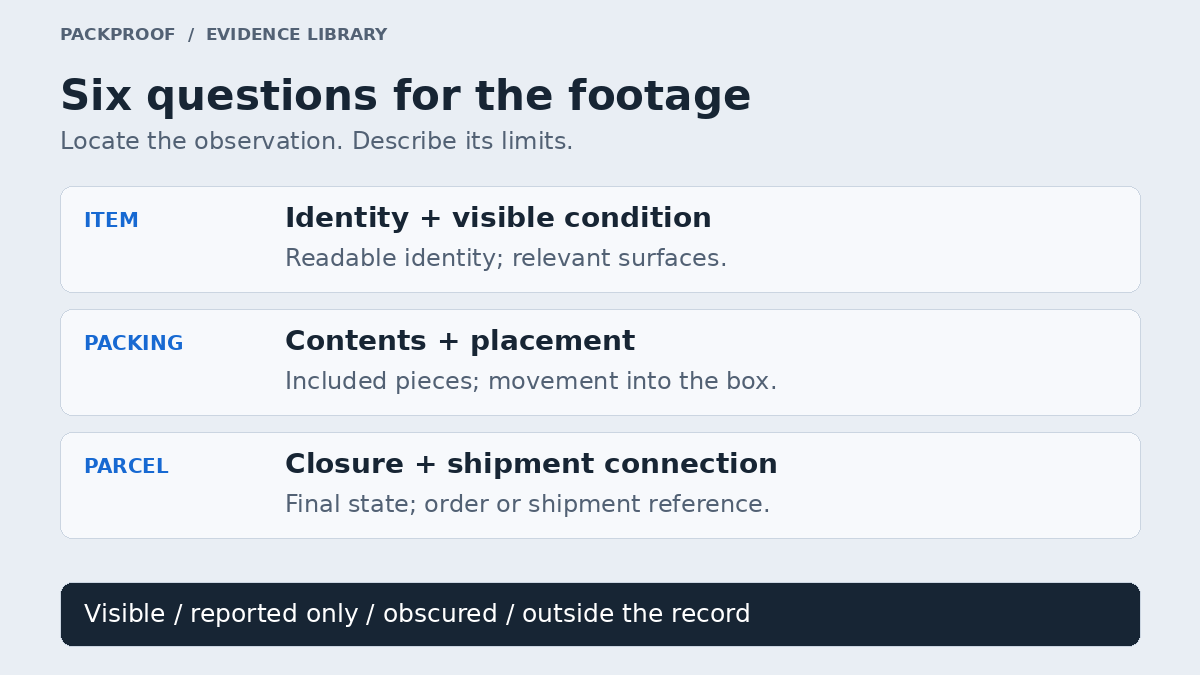
Diagram in words
Item review asks which item is shown and what condition is visible. Packing review asks what is included and how it enters packaging. Parcel review asks how closure ends and which shipment the parcel concerns. For each question, locate the observation and label it visible, reported only, obscured or unreadable, or outside the recording. These are review descriptions, not a completeness score.
Six questions to ask of the footage
| Review question | What a useful view contains | Common remaining gap |
|---|---|---|
| Which item is shown? | Overall appearance connected to a readable, relevant identifier. | A close-up label with no clear relationship to the item. |
| What condition is visible? | Relevant surfaces, disclosed marks, and vulnerable areas before wrapping. | Glare, a hidden underside, or condition described only aloud. |
| What is included? | The quantity and identifiable accessories, followed through placement. | A group on the table with no view of which pieces entered the carton. |
| How is it packed? | Visible protection, arrangement, and movement into the package. | The carton wall or hands conceal the placement. |
| How does packing end? | Closure and the visible final state of the same parcel. | Recording ends while the carton is still open. |
| Which shipment does it concern? | A clear relationship between the parcel and the recorded order or shipment reference. | A label appears separately without a supported connection to the parcel. |
Do not infer a missing answer from a neighboring one. Showing the correct model does not establish a unique serial number. Showing protective material on the table does not show how it was used. A readable tracking label does not reveal what is inside the carton.
Connect item identity to the wider view
Begin with enough context to recognize the object, then inspect the identifier relevant to the transaction. Depending on the item, that might be a serial number, model and variant, certification label, or a documented distinguishing feature. Some goods have no unique identifier; say so instead of treating an ordinary model number as unique. The identifier guide distinguishes product, unit, transaction, and shipment numbers.
The relationship matters as much as legibility. A separate close-up can be useful, but the reviewer should understand which item it depicts and whether it belongs to the same capture. If digits cannot be read reliably, mark the identifier as unreadable. Narration can supply a reported number; it does not turn the blurred image into visual confirmation.
For collectibles, a visible certification number is also different from authentication of the physical object. PSA's verification page warns that database verification does not eliminate risk and that genuine certification numbers can be copied. Keep lookup results attributed to their source. The collectibles documentation guide covers item-specific views in more detail.
Separate visible condition from function and concealed condition
Inspect the surfaces relevant to the listing and later comparison: corners, edges, exposed controls, holder surfaces, or a disclosed mark. Connect a close condition view to the overall object so a reviewer can locate the detail. A slow rotation can reveal different surfaces, but only those that remain in frame and in focus are actually recorded.
Describe the observation narrowly. “No crack is visible on the recorded front surface” is more precise than “the item was perfect.” Exterior footage does not reveal a hidden internal defect. A device powering on is a recorded event; it is not a comprehensive functional test unless the actual test and its scope are separately documented.
Do not open factory seals, grading holders, or protective enclosures just to fill a checklist. Record the accessible condition and identify what the enclosure prevents you from inspecting. Preserving the item takes priority over producing a superficially complete set of views.
Follow contents into the package
A contents view is strongest for this purpose when the expected pieces can be distinguished and their placement remains visible. Count repeated items in a way that can be followed. For an accessory bundle, show enough detail to distinguish the charger, cable, battery, or other components relevant to the order.
Then inspect the transition. Did the pieces on the table actually enter the parcel? Did wrapping hide the item before it moved out of view? Did another similar carton enter the working area? These questions identify limits in the footage; they do not establish that anything improper occurred.
Packing footage can show the arrangement and materials visible at that time. It does not certify that the packaging meets every carrier requirement or will withstand every handling event. The broader shipment evidence framework keeps packing observations separate from carrier and recipient sources.
Check the ending and the shipment connection
Find the last meaningful view. An open box, a closed flap, and an applied final seal are different recorded states. Note which closure surfaces are visible and which remain hidden. Avoid describing an unobserved closure as recorded, even when the final frame shows an apparently closed parcel. Use the final-seal framework when reopening, resealing, or later label application changes that ending.
Check how the record connects the parcel to the order or shipment. That association might appear in the capture and in the surrounding transaction record. State where it comes from. If a label is added later, identify the later observation separately instead of implying it appeared in the earlier video.
The recording's endpoint also bounds its reach. A sealed parcel in the last frame does not show what happened between capture and carrier acceptance or during transit. Weight, acceptance, tracking, and receipt observations belong to their own sources and times.
Use a coverage ledger, not a completeness score
For each important question, note a playback position and one of four plain descriptions: visible, reported only, obscured or unreadable, or outside this recording. A table makes the limitation explicit without reducing different questions to a misleading percentage.
Consider this hypothetical used-camera shipment. The positions are illustrative, not a customer record:
| Question | Position and observation | Description |
|---|---|---|
| Camera identity | At 00:18 the serial is readable and the view widens to the camera. | Visible |
| Included charger | At 01:06 the seller says “charger included,” but placement is behind the carton wall. | Reported only; placement obscured |
| Final closure | At 02:40 the top seam is taped; the bottom remains out of view. | Visible top closure; bottom outside the view |
| Recipient condition | No receipt recording is included. | Outside this recording |
A reviewer can now request a specific missing source or explain a limit. The ledger does not decide a refund, prove intent, or recreate the hidden action. For assembling the surrounding account, use the dispute evidence guide.
Match later questions to later evidence
If the eventual question concerns damage on arrival, an outbound packing record is only one part of the account. USPS's domestic claim guidance instructs claimants to retain packaging and contents and explains that inspection may be required. Consult the applicable service's current instructions; do not discard relevant physical material because a video exists.
Preserve the source recording and identify extracted stills or edited presentation copies. A summary should help someone find an observation, not conceal the uncertainty around it. Explore a sample Proof, compare packing video and photos, or browse the Shipment Evidence guides.
Sources and editorial scope
Sources reviewed October 3, 2026:
- PSA: Certification verification — limits of certification-number lookup.
- USPS: File a domestic claim — retaining packaging and contents for the applicable claim process.
The six questions, coverage ledger, and camera example are PackProof editorial analysis. No carrier, marketplace, or grading service is presented as endorsing this framework or PackProof.
See the record in context.
Explore how PackProof connects the order, available evidence, and shipping activity.
Open a sample Proof →