
E-Commerce Dispute Evidence: How to Build a Reviewable Shipment Record
E-commerce dispute evidence is most useful when a reviewer can identify the order, locate the relevant material, and distinguish recorded events from participant reports. A reviewable shipment record brings those sources together without turning them into a stronger conclusion than they support.
Start with the issue being raised. An item that did not arrive, a delivered package reported empty, and a disagreement about condition each create different questions. The same folder of attachments will not answer all three equally well.
Key points
- Begin with the question under review, then connect each relevant source to the correct order.
- Keep seller capture, buyer reports, and carrier events separately attributed.
- A concise evidence index helps a reviewer find the original material and understand its limits.

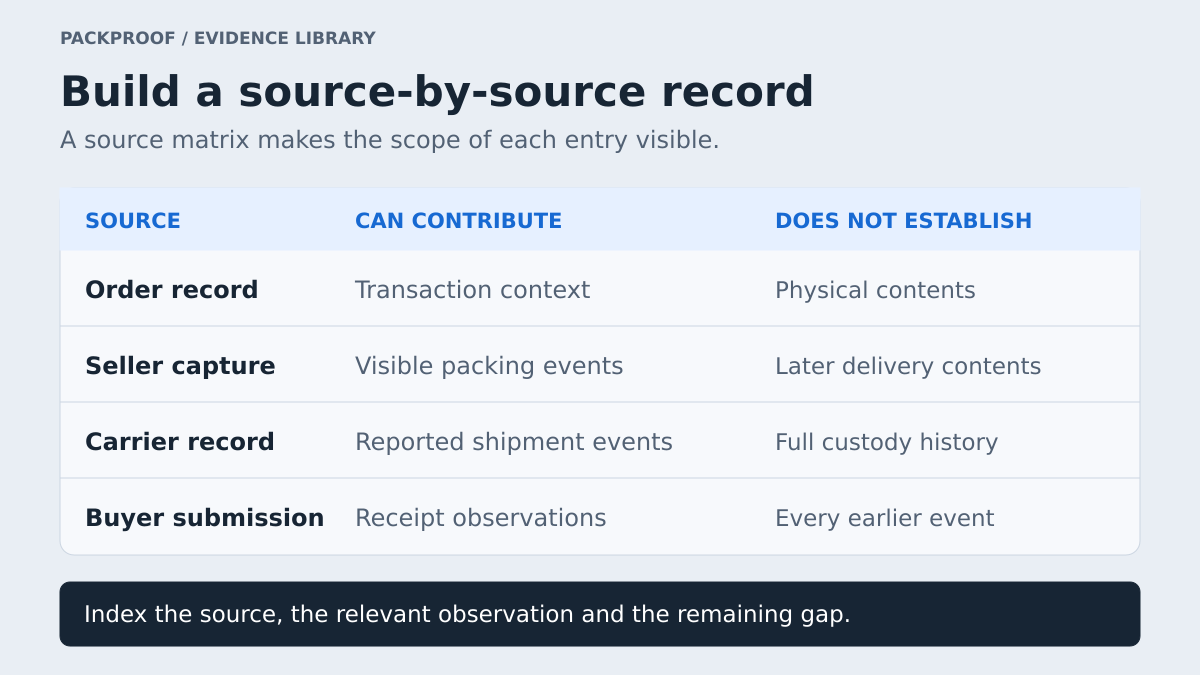
Diagram in words
An order record contributes transaction context but does not establish physical parcel contents. Seller capture contributes visible packing events but does not establish later delivery contents. A carrier record contributes reported shipment events but does not provide a full custody history. Buyer submissions contribute receipt observations but do not establish every earlier event. Preserve attribution and identify remaining gaps.
Define the question before collecting more files
Write one factual sentence describing the issue: “The buyer reports that the delivered package contained packing material but no camera.” Avoid deciding who caused the problem in that sentence. It should describe the question your evidence needs to address.
Next, identify the transaction: marketplace or store, order reference, item description, quantity, shipment tracking number, and any related return reference. A tracking number and an order number serve different purposes. Preserve their relationship, particularly when one order has multiple parcels or replacement shipments.
Save the listing or purchase description as it existed for the transaction where available. A current product page may have changed since the order. Identify what you actually retained rather than presenting a later copy as the original listing.
Build an evidence index with a source for every entry
PackProof recommends a small index that connects questions to sources. This is an organizational method, not a list of documents every marketplace promises to accept.
| Question | Source to review | What it can contribute | Important limit |
|---|---|---|---|
| What was ordered? | Order record and retained listing | Item, quantity, description, transaction context | Does not show what was physically packed |
| What was visible before shipping? | Seller packing capture | Recorded item, visible condition, packing steps | Covers only what remains visible in the recording |
| Which parcel was shipped? | Label, acceptance receipt, carrier record | Shipment identity and reported carrier events | Does not automatically establish contents |
| What did the recipient observe? | Buyer message, photographs, receipt recording | Recipient's account and recorded arrival condition | Timing and coverage may be incomplete |
| What happened during a return? | Return authorization, tracking, return capture | Separate return journey and recorded item state | Does not fill gaps in the outbound journey |
Give each attachment a short identifier such as E01 or E02. Describe its origin, date information, and relevance. “E03 — buyer-submitted photograph of opened parcel, received September 24” is more useful than “proof.jpg.” Keep the original filename in the index if you use a friendlier display label.
Separate observations, reports, and conclusions
An observation refers to something visible in a source: “At 01:12, the recording shows the camera being placed inside the inner box.” A report identifies what someone said: “The buyer reported an empty parcel in a message received the next day.” A conclusion is an interpretation of those materials.
These distinctions matter even when the sources agree. A carrier status reading “delivered” is a reported shipment event. It is not a recording of the recipient examining the item. A seller's note saying “working perfectly” is a statement unless the relevant operation is shown or documented separately.
Use precise descriptions throughout the record. “The serial number is readable in this frame” says something a reviewer can check. “This proves the entire transaction was correct” does not describe a bounded observation.
Preserve the material behind the summary
An index should point back to the underlying files. Retain original recordings and photographs where available. If you provide a shorter clip or a still frame for convenience, identify the source recording and the relevant time position. Do not replace the retained recording with an edited compilation.
Keep the timing fields distinct. The time stated by a device, the time a service received a file, and the time a carrier reports an event are different pieces of context. If the time zone is unknown, record that gap rather than choosing one silently.
Before sharing, check who needs access. Shipping labels can contain names, addresses, and contact details. Use the platform's case process or an appropriately controlled destination, and keep irrelevant customer information out of a public discussion.
Follow the process that owns the decision
A marketplace dispute, payment dispute, and carrier insurance claim may ask different questions. Check the current instructions in the actual case, including required fields, permitted attachment types, and response dates. A well-organized record supports that work; it does not replace it.
For example, USPS domestic claim guidance identifies documentation for insurance, value, and damage and instructs customers to retain packaging and contents. UPS supporting-document guidance calls for supporting records and describes photographs used for damage claims. These are specific processes, not a universal standard for all commerce disputes.
Example: a short review summary
For a hypothetical camera shipment, a useful cover note might read:
“Order C-104 concerns one camera body and one battery. E01 contains the order record. E02 is the seller's packing recording; the camera identifier is visible at 00:24 and the final seal at 02:08. E03 contains the carrier's shipment history. E04 is the buyer's message reporting a missing battery, with a photograph of the opened package. The recording shows a battery placed beside the camera before packing. The package interior is not visible after sealing, and there is no recording of delivery or first opening.”
That summary gives a reviewer specific places to look and states the gap. It does not require agreement with either participant before the material can be examined.
Check the record before submitting it
- Confirm every attachment belongs to the correct order and parcel.
- Label who supplied each source and what its dates represent.
- Point to the specific frames, pages, or messages relevant to the issue.
- Preserve conflicting material and explain missing coverage.
- Meet the case's current submission requirements and retain a copy of what you sent.
For an outbound preparation checklist, read what sellers should document before an order leaves. For the technical distinctions behind preserved files, read what makes digital shipment evidence trustworthy. The reviewer workflow and sample Proof show the PackProof context for examining shipment evidence.
Sources
External guidance reviewed September 26, 2026. The workflow and example above are PackProof editorial recommendations.
See the record in context.
Explore how PackProof connects the order, available evidence, and shipping activity.
See the reviewer workflow →