
Buyer Says the Box Was Empty: What Evidence Can a Seller Review?
When a buyer says a box arrived empty, review the order, the packing record, the parcel's identity, carrier information, and the buyer's account together. Each source can answer part of the question. None should be treated as automatic proof of what happened during an unrecorded part of the shipment.
Preserve the available material and respond through the marketplace or store's normal process. An empty-box report describes a problem; it does not establish when the contents became missing or who was responsible.
Key points
- Treat an empty-box message as a report to investigate, not a conclusion about either participant.
- Match packing evidence, the label, and carrier records to the same physical parcel.
- A packing recording and a delivery scan cover different events; neither supplies missing footage of the journey.

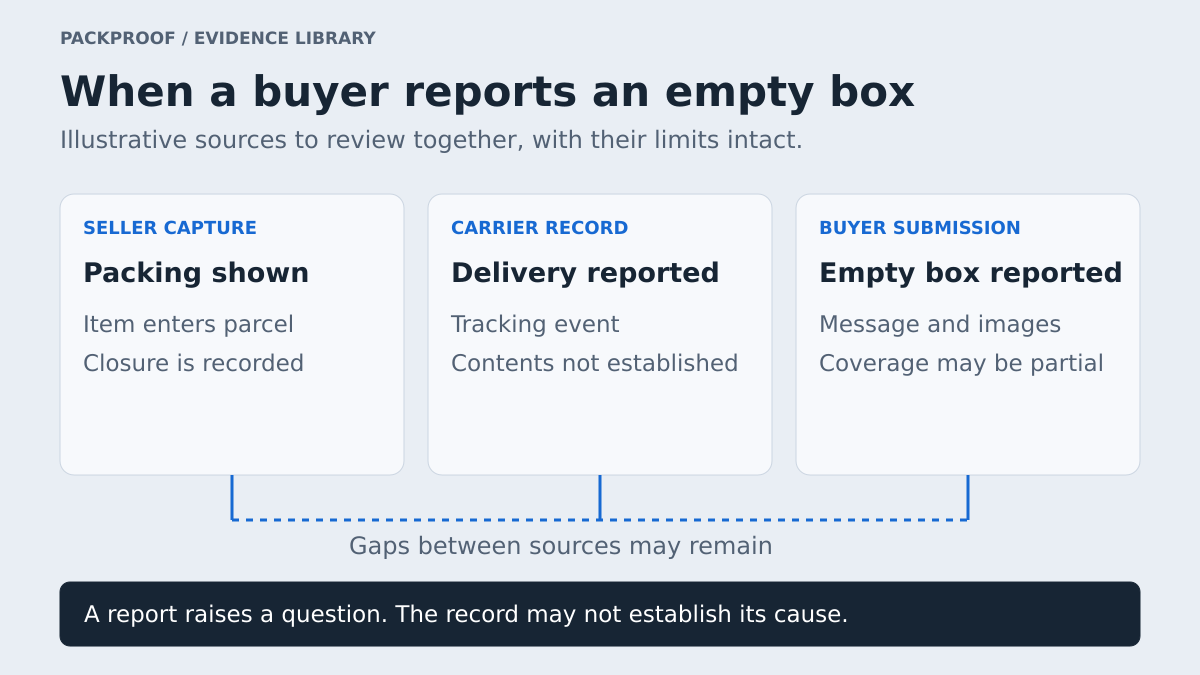
Diagram in words
Illustrative case: seller capture shows an item entering a parcel and the closure. A carrier record reports delivery but does not establish inspection of the contents. A buyer reports an empty parcel and submits images that may cover only part of receipt or opening. The dotted line represents gaps that may remain between these sources, not continuous observed custody. The available record may not establish when or why contents went missing.
Start with a neutral, specific response
Acknowledge the report and ask for information that can clarify it. Useful details include whether the parcel was open or visibly damaged on arrival, what packaging remained, and whether any carrier notice accompanied it. Request photographs of the exterior, label, closure, interior, and retained contents when the process permits.
Keep the request practical. A buyer may already have opened the parcel or discarded some packaging before contacting you. Do not ask them to recreate an opening and describe it as the original event. Record what is available now and what was not captured.
An example response is: “Thank you for letting me know. Please keep the box and remaining packaging while we review this. If available, send photographs of the shipping label, all sides of the box, the closure, and what was inside. Was the package already open or damaged when you received it?”
Confirm that the records concern the same parcel
Check the order reference, tracking number, package count, and item quantity. If an order shipped in two boxes, determine which parcel the report concerns. If a label was voided and replaced, distinguish the active shipment from the earlier label.
Compare observable package details across sources: dimensions, material, tape placement, printed marks, and any recorded seal identifier. These can support a comparison, but ordinary boxes and tape are not inherently unique. Do not describe a match as certain when the only common feature is a brown carton.
Review the packing sequence for actual coverage
Look for the point at which the item is identifiable, the point at which it enters the packaging, and the final closure. Ask whether the item or parcel leaves the frame, whether the recording stops, and whether the label can be linked to the sealed package.
A recording may show an item packed and the box sealed clearly. It still ends at a particular moment. If there is no coverage between that moment and carrier acceptance, describe that interval as unrecorded. A clear record of one stage should not be expanded into a claim about every later stage.
| Available material | Useful question | What to avoid concluding |
|---|---|---|
| Continuous seller packing recording | Is an identifiable item visibly placed into the parcel and sealed? | That the same contents necessarily reached the buyer |
| Photograph of a sealed box | What did the exterior look like at capture? | That the photograph establishes the contents |
| Acceptance receipt or carrier event | Which shipment was reported received by the carrier? | That the carrier inspected the contents |
| Weight information | What weight was recorded, by whom, and at what stage? | That a number alone identifies the packed item |
| Buyer photograph after opening | What is visible in the submitted photograph? | That it shows the complete first-opening sequence |
Treat weight as a source-dependent measurement
If weight information is available, identify its origin before comparing values. A number entered when creating a label is different from a reading shown on a packing-station scale. A carrier-provided measurement needs its own context, including units and the stage at which it was recorded.
Do not label any of these “carrier verified” unless the source actually establishes that. Compare like with like: gross package weight includes the carton and packing materials, while an item specification may describe only the product. Even a reliable weight can be consistent with more than one set of contents.
Use weight to identify questions for further review, such as an unexplained difference between two attributable measurements. It does not identify a person or explain the cause of a difference by itself.
Keep the marketplace process and carrier process distinct
Check how the relevant service categorizes the issue. For example, eBay's Money Back Guarantee policy directs buyers whose packages arrive empty to report that the item does not match the listing. A delivered status therefore does not, on its own, answer the contents question in that scenario.
For an eligible U.S. domestic insured shipment, USPS claim guidance addresses missing contents and instructs customers to retain packaging and contents for the claim process. Consult the applicable current instructions and case deadlines directly. Do not postpone a required marketplace response while collecting a separate carrier record.
Write a summary that states the remaining gap
Consider this hypothetical case: the seller has a recording showing a camera placed in a box and the box sealed. The carrier reports delivery. The buyer supplies photographs of an open box containing packing paper. No recording shows first opening, and there is no continuous record of the parcel between packing and receipt.
A careful summary is: “The seller's recording shows a camera packed and the parcel sealed. The carrier reports delivery of the associated tracking number. The buyer reports that the parcel contained only packing material and submitted photographs taken after opening. The available record does not show the first opening or establish what occurred between the recorded packing and the buyer's photographs.”
This preserves the apparent conflict without replacing missing evidence with an accusation. The reviewer can then assess the material under the relevant process.
Make the next shipment easier to review
Use a repeatable capture sequence that keeps the item, packing, closure, and shipment identity connected. Retain the order context and original capture. The guides to building a reviewable dispute record and packing video versus photographs explain how to organize those sources before a question arises. See the seller workflow for the PackProof context.
Sources
External guidance reviewed September 26, 2026. The evidence matrix and example are PackProof editorial recommendations.
See the record in context.
Explore how PackProof connects the order, available evidence, and shipping activity.
See the seller workflow →