
Return Evidence: Documenting Receipt, Condition, and the Return Shipment
Useful return evidence connects the original order to what the buyer received, what the buyer sent back, and what the seller received on return. Keep these stages separately labeled. A recording from one stage cannot fill an unrecorded interval at another.
The goal is a comparison a third person can follow: which item is shown, what condition is visible, which accessories are present, and how the package was closed. Both participants benefit from the same factual approach.
Key points
- Outbound packing, buyer receipt, return packing, and seller receipt are separate capture stages.
- Use item identifiers and repeatable views to make condition comparisons easier.
- Record missing coverage and preserve the original files; a comparison does not automatically establish causation.

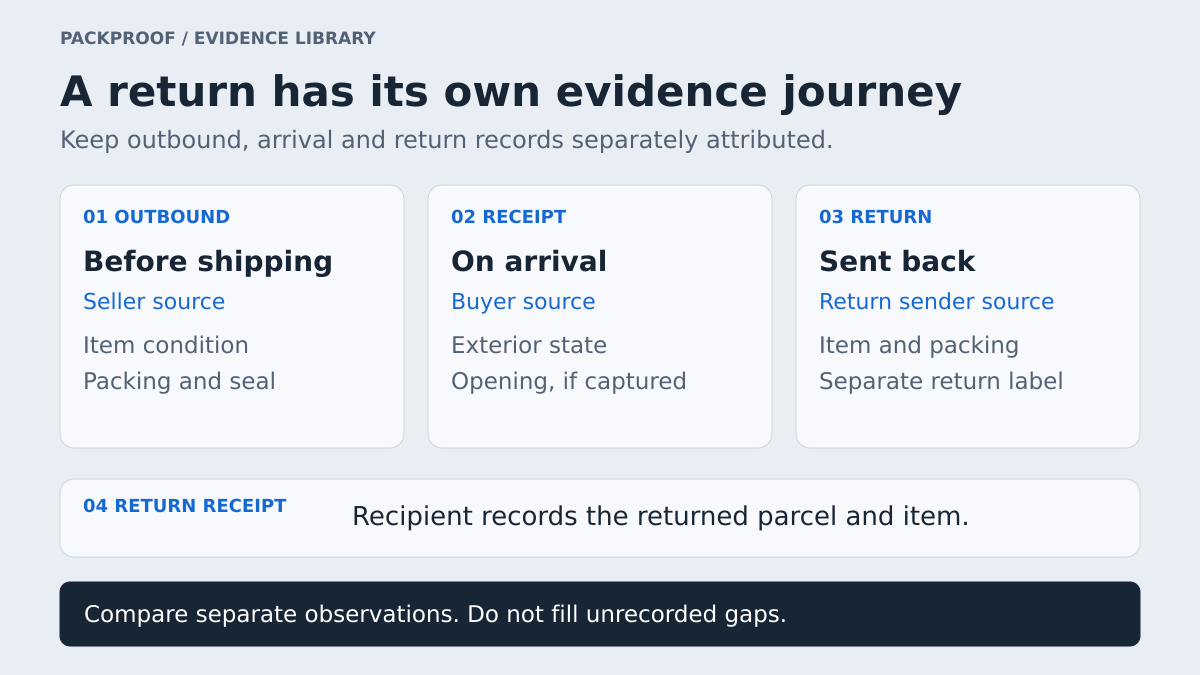
Diagram in words
Stage 1: the seller records visible item condition, packing and seal before outbound shipping. Stage 2: the buyer records arrival observations, including opening if captured. Stage 3: the return sender documents the item, packing and separate return label. Stage 4: the return recipient records the returned parcel and item. Each is a separate source and moment. Comparisons do not fill unrecorded gaps.
Use four checkpoints, even when some are missing
A return can involve four sets of observations. The earlier outbound record supplies context, while later records add their own information. Do not overwrite the outbound description with the condition reported during a return.
| Checkpoint | Typical contributor | Capture or retain | Limit to state |
|---|---|---|---|
| Original packing | Seller | Item identifiers, visible condition, included parts, packaging | What was visible before the outbound parcel was closed |
| Original receipt | Buyer | Exterior, opening if recorded, contents, observed issue | Whether the first opening was captured or the package was already open |
| Return packing | Buyer | Same identifiers, current condition, included parts, packing and closure | The condition and sequence visible at return capture |
| Return receipt | Seller | Return label, exterior, opening, contents and inspection | Whether any handling occurred before capture began |
If there is no original receipt recording, write “not captured.” A missing recording is a coverage limit, not evidence that either participant behaved improperly.
At buyer receipt, record the condition you actually encounter
If documenting receipt, begin with the parcel as it is when recording starts. Show the label and exterior, then any visible damage or unusual closure. Keep the package in view while opening when practical, without creating a safety hazard or damaging the contents for a better camera angle.
Show the item and included accessories before rearranging them extensively. For a specific concern, take a readable view of that area and a wider view showing where it is on the item. “A crack is visible on the lower-right corner of the case” is more useful than “the item is ruined.”
If the package was opened earlier, state that. A later photograph may still document a visible condition; it simply does not show the first opening. Keep the buyer's explanation alongside the media as a participant report.
Before sending a return, match the item and contents
Follow the return instructions for the actual order, including the authorized destination and provided label where applicable. Documentation should accompany the required process rather than create a separate route around it.
Use an identifier that can be compared with the outbound record: a serial number, grading label number, distinct marking, or other available detail. Record the whole item as well as the identifier. A close-up of a label alone may not show which physical item it is attached to.
Place the included parts in view and record what is present. List exceptions accurately: “one charging cable included; original adapter not available.” Do not silently assume that the contents match the original order.
As one policy example, eBay's condition of returned items policy addresses returning the purchased item in the received condition and including original items and accessories, with additional category requirements. Read the policy applicable to the transaction; this guide does not determine refund eligibility or deductions.
Record return packing as its own sequence
Show the item's condition before wrapping, then its placement, protective materials, final closure, and the associated return label. For delicate objects, position the camera so the record can be made without unnecessary handling. Preserve the return's tracking reference separately from the original outbound reference.
If there is a recording interruption, keep that fact visible in the record. Do not join clips in a way that suggests one continuous sequence. A short written note can explain a practical interruption without claiming to document what happened while the camera was off.
Retain the return receipt or acceptance information if supplied. Keep original media available and identify any excerpts as excerpts. A summary attachment may help locate a detail, but it should still lead back to the underlying material.
At seller receipt, compare matching views
Confirm the return parcel's identity before comparing contents. Record its exterior and opening if practical. Then compare the same identifiers, surfaces, and accessories shown in the earlier material.
Use consistent language in your notes:
- Observed: “The returned camera shows serial number 4726 in the current capture.”
- Compared: “That number matches the number readable in the outbound capture.”
- Reported: “The buyer stated that the shutter stopped operating.”
- Unknown: “No functional test is visible in either recording.”
These statements can coexist. Matching an identifier does not establish every aspect of condition, and a visible difference does not by itself identify when it arose.
Example: a collectible case with a reported crack
Imagine a graded comic shipped inside a rigid case. The outbound capture shows the front label and upper corners clearly, but glare obscures the lower edge. The buyer later reports a crack along that lower edge and supplies a photograph. The return capture shows the same readable label number and the reported crack.
The record supports a comparison of the label number and the later visible damage. It does not establish that the lower edge was intact at outbound capture, because the relevant area was obscured. Nor does it establish the cause of the crack.
For the next shipment, the useful improvement is concrete: adjust lighting and capture the lower edge before packing. An evidence gap becomes an operational correction without requiring a claim about fault.
Share a concise return record
Create a short index containing the order reference, return reference, contributor for each file, relevant item identifiers, visible condition differences, and missing coverage. Include the case correspondence needed to understand why the return occurred. Keep customer addresses and unrelated information within the appropriate access scope.
Read how to organize a dispute record for the review packet, and how to document high-value collectibles for item-specific checkpoints. The buyer workflow explains the PackProof context for participant evidence.
Source
External guidance reviewed September 26, 2026. The four-checkpoint model, examples, and capture recommendations are PackProof editorial guidance.
See the record in context.
Explore how PackProof connects the order, available evidence, and shipping activity.
See how buyer participation works →