
How to Document High-Value Collectibles Before Shipping
Document a collectible by showing what distinguishes it, the visible condition that matters to the transaction, any grading label or holder, and the packing sequence through the final seal. Keep those observations connected to the sale or submission reference. A title and grade alone may describe many different items.
For collectors, small differences matter: a corner mark, a holder crack, an edition, a serial, or an accessory can change the question being reviewed. Capture these details while they are accessible, using handling that does not put the item at unnecessary risk.
Key points
- Record the item, its label or identifiers, and its holder as separate details.
- Capture condition-sensitive views before protective materials hide them.
- Attribute certification lookup results to the grading service and record when checked.
- Shipment documentation does not perform authentication or assign a grade.

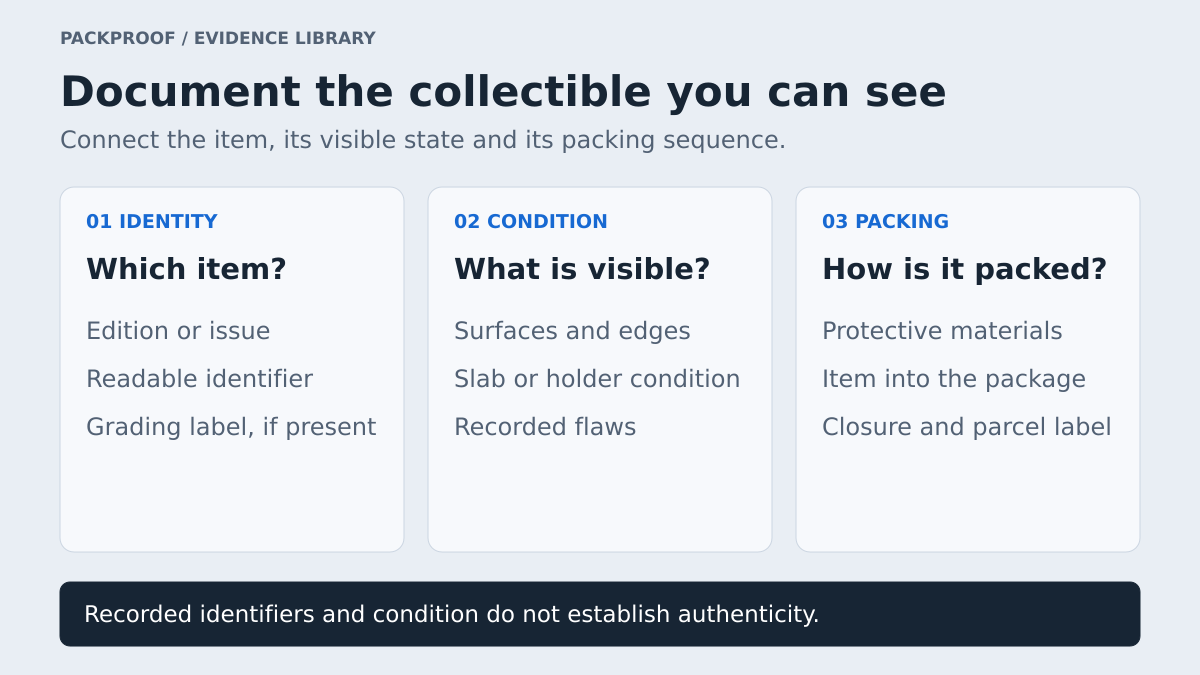
Diagram in words
Identity: capture the edition or issue, readable identifiers, and any grading label. Condition: document visible surfaces, edges, slab or holder condition, and recorded flaws. Packing: show protective materials, the item entering packaging, closure, and parcel label. These observations document visible details; they do not authenticate the collectible or independently verify its grade.
Separate the item, label, and holder
A graded collectible has several things to document. The item is one object; the label records a service's description and grade; the holder has its own visible condition. A scratch on a holder should not be described as a scratch on the enclosed card unless the evidence supports that distinction.
Show an overall view first, then the readable label and relevant details. Photographing or recording only the label leaves the rest of the object unobserved. Recording only the front may miss damage to the back or edges of the holder.
Where a certification lookup is relevant, use the issuing service's official tool. CGC's verification page allows a certification number to be checked against the description and grade in its database; PSA provides its own certification lookup. Attribute the result to that service and note the date checked. A copied lookup result should not be presented as PackProof authenticating the physical item. The identifier capture guide explains how to keep the number, its physical source, and the order association distinct.
Choose views by collectible type
Use this table as a capture planning aid. It is not a grading checklist and does not replace specialist assessment.
| Collectible | Identity details | Condition views to consider |
|---|---|---|
| Graded comic | Title, issue, variant, certification label | Front and back, holder edges, visible cracks or scuffs |
| Graded trading card | Player or character, set, card number, certification label | Front and back, readable label, holder surfaces and edges |
| Raw comic or card | Edition, variant, card or issue number, distinctive visible features | Accessible surfaces, corners, edges, and disclosed defects |
| Collectible figure or model | Release or edition, identifying marks, included components | Fragile parts, paint condition, accessories, and retail packaging |
| Collectible electronics | Model, serial where present, included accessories | Exterior condition and any limited operation check actually performed |
Do not remove an item from a graded holder to improve the view. For raw items, avoid repeated handling merely to obtain additional angles. If a surface cannot safely be shown, state that limit rather than implying it was inspected.
Make reflections and small details manageable
Glossy holders can reflect the camera, light fixture, or room instead of revealing the surface. Adjust the light and camera angle before beginning the packing session. Test whether the label is readable in playback and whether the relevant mark remains visible without extreme zoom.
Use a clean workspace and hold the item steadily. Show the overall object after any close-up so a reviewer can connect the detail with the item being packed. A tight image of a crack with no surrounding context may be difficult to match to another view.
Keep the language as specific as the image. “A short scuff is visible near the upper-right edge of the holder” is inspectable. “Perfect condition” reaches beyond a limited recording and may conflict with small details the camera did not reveal.
Preserve what the transaction actually described
Retain the sale description, relevant listing images, disclosed flaws, included accessories, and order reference. For a grading submission, retain the submission inventory and reference instead. A sale and a grading submission have different surrounding records even if the physical packing sequence is similar.
If there are multiple collectibles in one parcel, make the count and identities clear. Record the order in which each item enters protective material and the package. For multiple parcels, identify which items belong in each one.
A simple private inventory can prevent ambiguity:
| Parcel | Item reference | Quantity | Relevant note |
|---|---|---|---|
| A | Certification ending 4821 | 1 | Disclosed holder scuff shown before wrapping |
| A | Certification ending 7316 | 1 | Front, back, and holder edges shown |
| B | Submission item 03 | 1 | Raw item in protective holder; reverse not removed for inspection |
This is an illustrative inventory. Keep the complete identifiers in the actual authorized record; the shortened examples here are for explanation.
Record protection, placement, and closure
Prepare appropriate packaging before capture. Keep the collectible visible as protective layers are added, then show the wrapped item entering the parcel. Continue through the final closure and show the shipment reference on the finished package.
Document how the item is positioned and supported, but avoid implying that a recording certifies packaging performance. A camera can show the materials used; it does not test whether they will withstand every handling event.
Review the saved recording before dispatch. Look for the easily missed details: a reversed label, unreadable certification digits, glare across a disclosed mark, or a second item added outside the frame. Use the six packing-video review questions to identify coverage gaps. The high-value shipment checklist covers the wider final review.
Comparing an outbound record with a later report
If a buyer reports a damaged holder, compare the same surfaces where possible. Identify the outbound source, the buyer's separate source, and any interval neither observes. If a feature is visible in one image and obscured by glare in another, the comparison may remain inconclusive.
Do not treat a mismatch as an automatic finding about who caused it. Differences in angle, lighting, focus, or item identification may need resolution first. The return evidence guide explains why receipt and return records should retain their own source context.
What this means for a collectible record
The useful result is a clear account of the particular collectible and packing session, including unresolved details. Shipment documentation does not assign a grade, establish authenticity, or determine responsibility for a later condition difference.
Explore the seller workflow and sample Proof, compare video and still images, or browse Collectibles & High-Value Items for related guidance.
Sources reviewed
- CGC: Verify certification — official description and grade lookup.
- PSA: Certification verification — official certification lookup.
Sources reviewed September 26, 2026. Capture tables, examples, and handling observations are PackProof's editorial recommendations, not grading-service requirements.
See the record in context.
Explore how PackProof connects the order, available evidence, and shipping activity.
Open a sample Proof →