
How to Document a High-Value Shipment Before You Send It
Document a high-value shipment by recording the item's identity and visible condition, showing the actual packing process through the final seal, and connecting that package to its order and shipping reference. Check the saved record before handoff. A recording discovered to be unreadable after dispatch cannot recover the missing details.
“High value” has no single threshold for this workflow. Use it when the transaction's value, rarity, condition sensitivity, or replacement difficulty justifies closer attention. The goal is a record that another person can inspect without relying on your memory of the packing session.
Key points
- Plan the views you need before covering or sealing the item.
- Make the connection between the order, item, and finished parcel easy to inspect.
- Check the saved recording before handing the package over.
- Keep shipping service choices and claim requirements separate from capture quality.

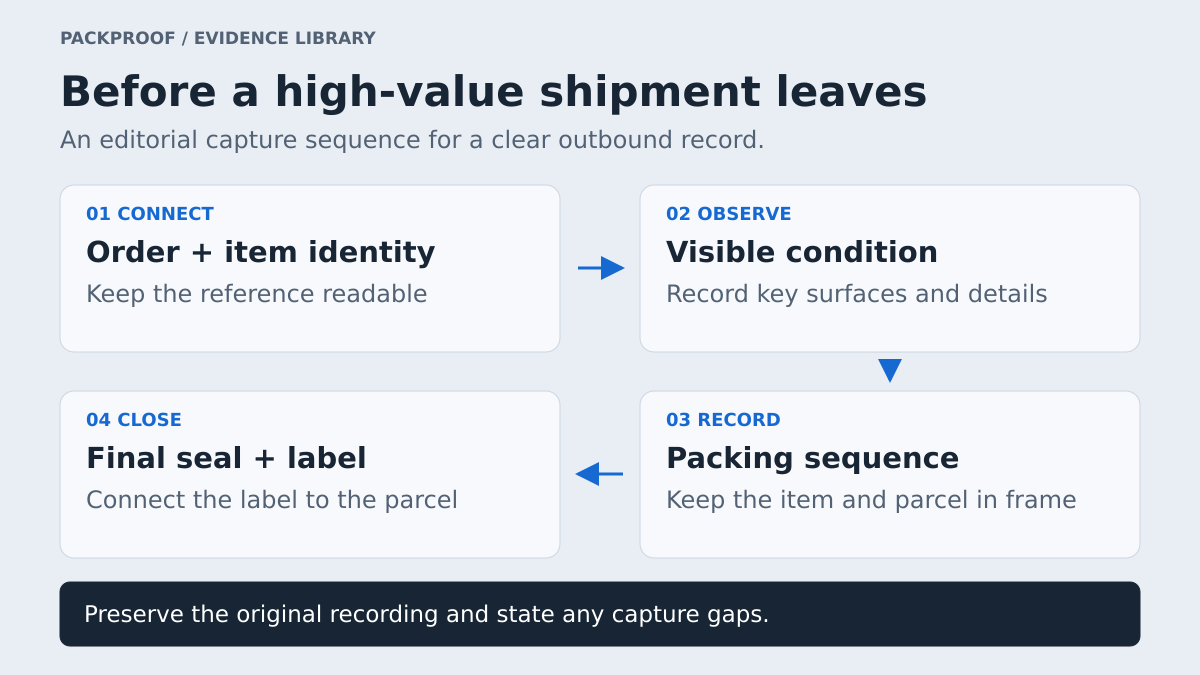
Diagram in words
Step 1: link order context to a readable item identifier. Step 2: record relevant visible condition. Step 3: keep the item and parcel visible during packing. Step 4: record the final seal and connect the shipping label to the parcel. Preserve the original recording and describe any gaps; this sequence does not document later transit or delivery.
1. Define exactly what is being shipped
Start with the agreed contents. Save the order reference, relevant listing description, disclosed flaws, quantity, and included accessories. For bundles, make a short inventory. “Camera kit” is less useful than a body, a named lens, two batteries, and a charger.
Note the identifiers that distinguish this item from similar stock. Record only identifiers you can actually inspect; do not invent a serial number for an item that has none. A distinctive mark can help comparison, but it should be described as a visible feature rather than a unique identity guarantee.
Preserve value documentation separately. USPS's domestic claim guidance, for example, lists documents such as sales receipts and paid invoices for establishing value. The amount on a sales document and the condition shown during packing answer different questions.
2. Prepare the capture before handling the item
Use a stable camera position, enough clear workspace, and lighting that reveals details without washing out labels or glossy surfaces. Test the view with the box you will actually use: a large carton can conceal the item or block the camera once you begin packing.
Prepare the protective materials, label, and any accessories beforehand. Confirm available storage and power, then make a short test recording. Play it back at normal size. Can you read an identifier? Are the relevant surfaces in focus? Can you see inside the open box?
These checks are especially useful when a holder, protective bag, or wrapping will make a detail inaccessible later. Do not remove protective packaging solely for a better recording if doing so could damage the item.
3. Capture the details that could matter later
The following is a suggested capture plan, not a marketplace or carrier submission requirement.
| Checkpoint | Capture | Useful quality check |
|---|---|---|
| Overall identity | Complete item and distinguishing model or variant | A reviewer can tell what product is shown. |
| Specific identity | Readable serial or certification label where present | Digits are legible in playback. |
| Condition | Relevant surfaces and disclosed marks | Lighting reveals the feature being described. |
| Contents | Each included component or accessory | Quantity and identity are clear before wrapping. |
| Packing | Item placement and protective materials | Hands and carton walls do not conceal the main actions. |
| Closure | Closing flaps, seal, and shipment reference | The transition to the finished parcel remains visible. |
If demonstrating operation, state the test's scope. A laptop displaying a startup screen shows that particular event. It does not establish battery endurance, every port's operation, or performance after transit.
For cards, comics, and other condition-sensitive goods, use the additional checkpoints in documenting high-value collectibles.
4. Keep the actual packing and final seal visible
Record the transition from the identifiable item to the sealed parcel. Move slowly enough for relevant actions to remain inspectable. A spoken description can provide context, but visible evidence should support it: saying “the charger is included” is weaker than showing the charger entering the package.
Once the item is wrapped, keep that wrapped item and its movement into the box in view. Show the label on the finished parcel, not only a loose label lying nearby. If the label is changed or the box is reopened, preserve the subsequent session and explain which version was dispatched. The final-seal guide distinguishes open, closed, sealed, labeled, and handed-off states.
Do not substitute a staged repeat for a missing recording. A reenactment may explain a packing method, but it does not document the original event.
5. Treat package weight as a separate observation
If you record weight, show the finished parcel and readable scale display, identify the unit, and note the source. A seller's scale reading is different from a carrier's recorded measurement or a weight entered when buying a label.
Avoid using a weight match to claim that the contents must be unchanged. Different contents can have similar mass; packaging and measurement conditions can also differ. Weight is useful context when its source and timing are clear.
6. Perform a final record check
Before handoff, review these five points:
- The saved record opens and plays through the final seal.
- The item, key identifiers, accessories, and condition views are readable.
- The order and parcel references match the intended shipment.
- Any interruption, off-camera movement, or later repacking is documented.
- The original is retained and access is appropriate for the intended reviewer.
Then keep the handoff receipt and subsequent carrier events as separate sources. The shipment evidence overview explains how those sources fit together.
What a complete packing record still leaves open
An illustrative watch shipment might show the case reference, visible marks, included box, protective layers, and sealed carton. That record can support a description of the recorded packing session. It cannot establish the watch's full service history, independently authenticate it, or observe every later handling event.
Capture quality also does not determine shipping eligibility, coverage, service limits, or a claim outcome. Check the applicable provider's current terms for the shipment itself and its instructions if a claim occurs. Documentation is one part of preparing a shipment; careful packaging and the appropriate service remain separate decisions.
Put the record to use
See the seller workflow, inspect a sample Proof, or compare packing video with photos. Browse the Shipment Evidence collection for the underlying documentation framework.
Source reviewed
- USPS: File a domestic claim — consulted for value documentation. Sources reviewed September 26, 2026. The capture checkpoints and review sequence are PackProof recommendations.
See the record in context.
Explore how PackProof connects the order, available evidence, and shipping activity.
See the seller workflow →