
Why the Final Seal Matters in a Shipment Record
The final seal matters because it records the point at which visible packing ends and the finished parcel begins. A useful view connects the item and contents already shown to the actual closure of the same box. It does not make the parcel tamper-proof, certify that every seam was secure, or document later custody.
For a seller, the practical question is not simply “Was tape visible?” It is whether another person can follow the transition from an open parcel to the last recorded closed state and understand any interruptions, reopening, labeling, or gaps. This guide is PackProof editorial guidance about documenting that transition; carrier packaging rules remain separate.
Key points
- The final seal marks the recorded transition from accessible contents to a finished parcel.
- Show the closure process and inspectable seams, not only a box that already appears closed.
- Treat reopening, resealing, labeling, and carrier handoff as distinct events with their own times.
- A recorded seal does not establish what happened after capture or certify packaging performance.

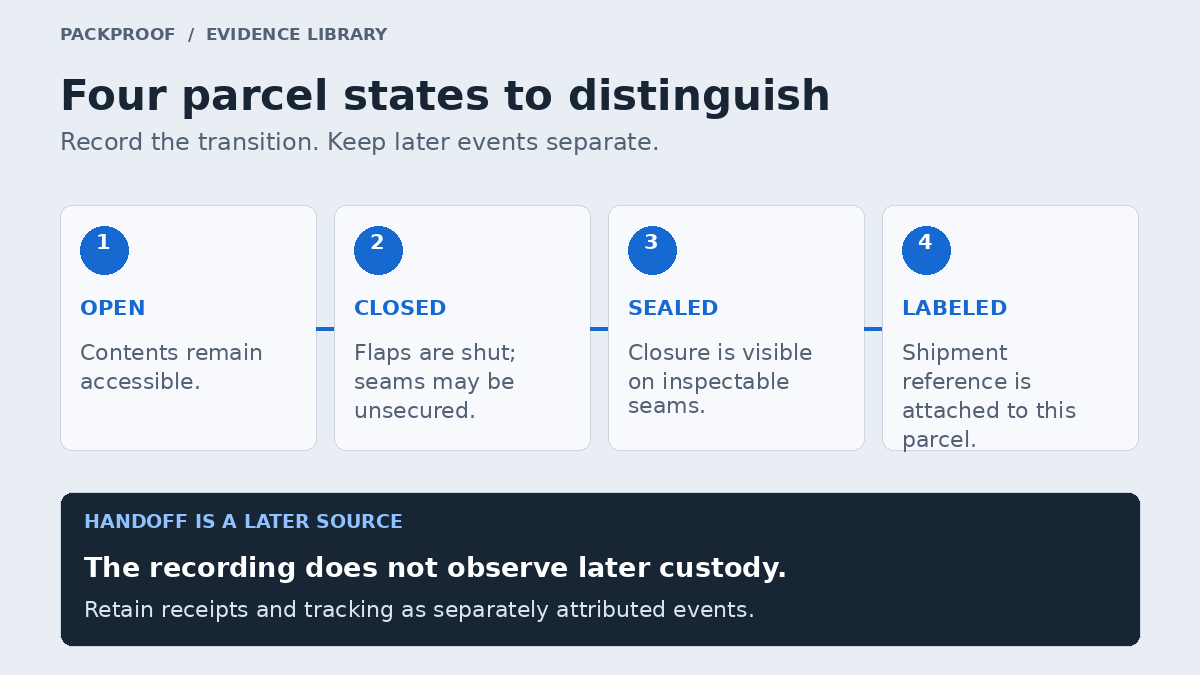
Diagram in words
Open shows accessible contents. Closed shows folded flaps but not necessarily secured seams. Sealed shows the closure applied to visible seams. Labeled connects the finished parcel to a shipment reference. Carrier handoff is a later source; the recording does not cover the interval after it ends.
Treat the final seal as a boundary in the record
A packing session contains several different states. Naming them prevents a still image of a closed box from being mistaken for a record of the closure itself.
| Parcel state | What may be visible | What remains unresolved |
|---|---|---|
| Open | Contents, protective material, inside surfaces | How the parcel will be closed |
| Flaps closed | The box appears shut | Whether closures and seams were secured |
| Sealed | Tape or another closure is applied to visible seams | Hidden surfaces and any later reopening |
| Labeled | A shipment label is visibly associated with the parcel | Whether that label remained attached or was later replaced |
| Handed off | A separate receipt or carrier event may report acceptance | Events between recording and acceptance, unless another source covers them |
These states are not a score. A recording may cover one clearly and another poorly. Describe the last state that is actually inspectable rather than calling every closed box “fully documented.”
Keep continuity from the contents to the closure
Before the box closes, make the relevant contents and their placement visible. Then keep the same parcel identifiable while the flaps close and the sealing material is applied. If the carton leaves the frame, another similar carton appears, or the camera points away during closure, the footage has a continuity gap.
Continuity does not require an elaborate camera move. It requires a view in which the parcel's movement can be followed. A stable wide view may be more useful than a dramatic close-up that loses the box. The clear packing-recording workflow explains how to test that view before actual packing.
If a detail view is necessary, connect it to the wider view. For example, show the top seam in context before moving close enough to inspect how the tape crosses it. A close-up of tape on cardboard, by itself, may not identify the parcel or show which closure surface is pictured.
Show the closure surfaces that matter
The shape of the package determines what can be inspected. On a conventional slotted carton, the center seam and the two edge seams on the top form one closure area. The bottom may have been sealed before the item was packed and will need its own view if it is relevant. Mailers, tubes, reusable cases, and manufacturer packaging have different closures.
Plan the view around the actual packaging rather than forcing every parcel into the same checklist. When rotating the finished package, keep the parcel in frame and handle it safely. Do not lift a heavy or fragile shipment merely to obtain a camera angle.
FedEx's current U.S. packing guidance describes applying specified tape across top and bottom flaps and seams using an H-taping method. UPS's U.S. packaging tips separately say to use shipping tape and securely seal closures and seams. Those are carrier packaging instructions. PackProof's recommendation to record visible closure surfaces is an evidence-capture practice, not a substitute for following the applicable carrier's requirements.
Distinguish an ordinary closure from a recorded seal identifier
“Seal” can mean ordinary shipping tape, a security label, a numbered tag, or a manufacturer closure. Describe what is actually present. Ordinary clear tape has no inherent unique identity. A numbered or patterned security seal may carry an identifier, but the number must be readable and connected to the same parcel for it to add item-specific context.
Use restrained wording:
- Visible closure: tape is visible across the recorded top seam.
- Readable seal identifier: seal number 004821 is readable on the closure in the source recording.
- Unseen surface: the underside was not shown after packing.
- Unknown interval: the recording ended before carrier acceptance.
Avoid “tamper-proof” unless a qualified product specification supports that precise claim. Even tamper-evident material is designed to indicate certain interference under defined conditions; a recording does not test every way it could be removed, damaged, bypassed, or replaced.
Connect the label without exposing more than the record needs
A shipping label helps connect the finished parcel to a shipment reference. Show enough context to make it clear that the label is attached to the same package, then capture the relevant tracking or order association in the protected transaction record. A loose label on the table does not show that it was applied to the recorded carton.
Do not publish an unredacted shipping label merely to demonstrate the technique. Recipient names, addresses, barcodes, and complete tracking references should remain within the people and systems that need them. A public example can use synthetic data or a separately redacted derivative while the source remains preserved.
If the label is created or applied after the packing video, keep that later capture as a separately timed observation. Do not imply that the earlier file included a label it did not show. The six packing-video review questions help describe that limit.
Record reopening and resealing as new events
A parcel may need to be reopened because an accessory was missed, an address changed, a quality check failed, or packaging needed correction. Reopening does not make the record unusable, but it changes which closure was final.
Preserve the earlier file. Capture the actual correction and resealing where practical, and state why the later event occurred. Link the files in order. The dispatched state is the state after the last documented change, not whichever clip looks cleanest.
| Situation | Record treatment | Do not imply |
|---|---|---|
| Tape lifted before dispatch | Record the reopening and new closure | The first seal remained intact |
| Label replaced | Keep the label association events distinct | The first label was dispatched |
| Recording stopped mid-seal | Retain both files and identify the missing interval | The files form one uninterrupted view |
| Parcel repacked in a new box | Treat it as a new parcel state and reconnect the shipment reference | The original box was the one handed off |
A staged demonstration after dispatch may explain a method, but it cannot restore the original unrecorded closure.
Perform a final seal review before handoff
Review the saved material while the parcel is still available:
- Can the reviewer follow the same parcel from visible contents into closure?
- Are the relevant closure surfaces and any seal identifier readable?
- Is the label visibly connected to the finished parcel, or clearly documented as a later event?
- Are interruptions, reopening, resealing, or unseen surfaces stated plainly?
- Does the saved file play through its actual ending?
Then retain carrier acceptance and tracking as separate sources. A receipt can report that a parcel entered a carrier process; it does not add an interior view or retroactively observe the seal between recording and handoff.
The high-value shipment guide places closure within the larger item, condition, contents, packing, and dispatch workflow. Browse Shipment Evidence or inspect a sample Proof to see the surrounding record.
Sources and editorial scope
Sources reviewed October 10, 2026:
- FedEx: Packing tips and how-to guides — current U.S. guidance for tape, seams, and the H-taping method.
- UPS: How to pack your shipments — current U.S. guidance for shipping tape, closures, seams, and labels.
The parcel-state framework, recording workflow, and review questions are PackProof editorial guidance. They do not certify packaging, uninterrupted custody, carrier acceptance, or a claim outcome.
See the record in context.
Explore how PackProof connects the order, available evidence, and shipping activity.
See the seller workflow →