
Serial Numbers, IMEIs, and Unique Identifiers: What to Record Before Shipping
Before shipping an identifiable item, record the relevant serial number, IMEI, certification number, or other unit-level identifier in a readable view that remains connected to the physical item and the order. A number copied into a note is useful context; a clear view of where it appears provides a different observation.
Not every barcode or printed number uniquely identifies one unit. Model numbers often describe a product type, order numbers identify transactions, and tracking numbers identify shipments. This guide gives electronics and high-value sellers a practical identifier workflow without treating any number as independent proof of authenticity, ownership, function, or condition.
Key points
- First identify whether a number describes a product type, a specific unit, a component, or a shipment.
- Show the identifier on the physical item and enough surrounding context to establish where it appears.
- Record multiple relevant identifiers separately, especially for bundles and dual-SIM devices.
- Preserve the full value in the restricted transaction record and redact public examples deliberately.

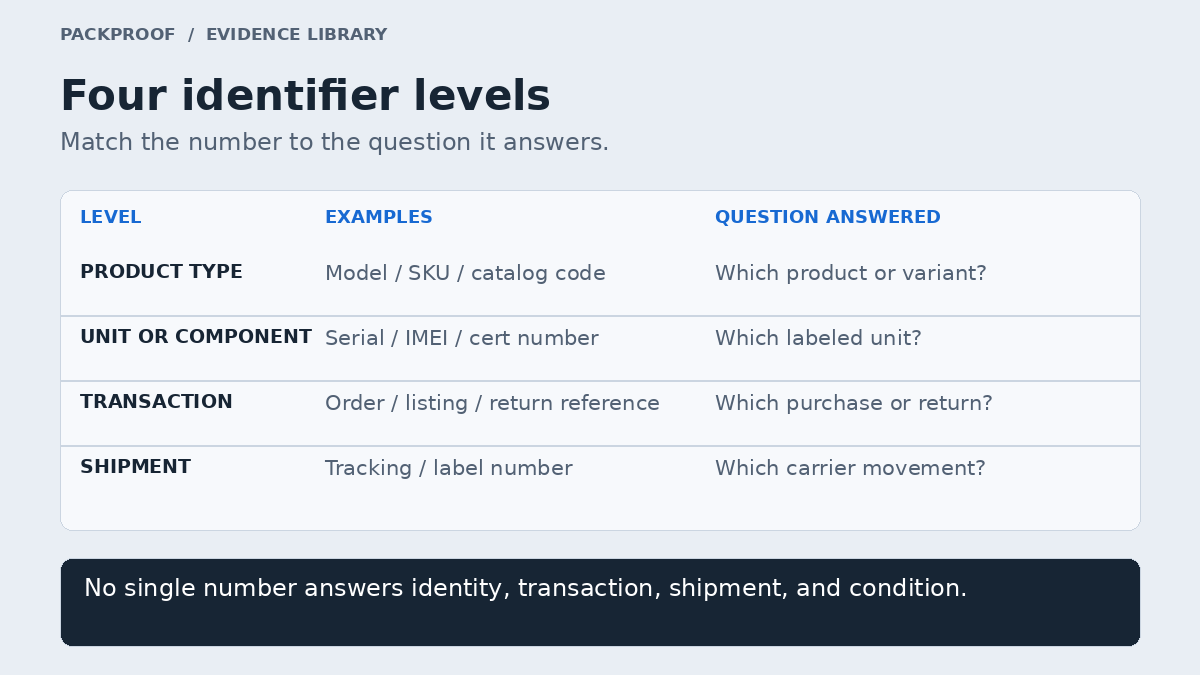
Diagram in words
Product-type identifiers such as a model or catalog code describe a product class. Unit or component identifiers such as a serial number or IMEI may identify a labeled unit. Transaction identifiers connect the evidence to an order. Shipment identifiers connect the parcel to a carrier record. No one identifier answers all four questions.
Identify what each number refers to
Start by classifying the identifier before deciding what to capture. The category determines the question the number can help answer.
| Identifier level | Examples | What it can connect | What it does not establish by itself |
|---|---|---|---|
| Product type | Brand, model, SKU, UPC or other catalog code | The item to a product description or variant | Which individual unit is shown |
| Unit or component | Manufacturer serial, IMEI, certification number, component serial | The recorded value to a specific labeled unit when the scheme is unit-level | Authenticity, ownership, function, or current condition |
| Transaction | Order number, listing reference, return authorization | The record to a purchase or return context | The physical identity of the item |
| Shipment | Tracking or label number | The parcel to a carrier shipment record | The identity or condition of contents |
The word “unique” should be used carefully. Treat an identifier as unit-level only when its issuer or device documentation uses it that way. Transcription errors, reused packaging, copied labels, counterfeit markings, database errors, or a misunderstood number can still create a false association.
Find the identifier on an authoritative surface
Prefer the location identified by the manufacturer or issuer: a device settings screen, an engraved label, a certification holder, a component label, or another documented surface. If the item cannot be powered on, original packaging or an account page may provide a reference, but that source should be labeled separately.
Apple's current support guidance says serial numbers and IMEI/MEID values can appear in device settings, on certain device or SIM-tray surfaces, in Finder or Apple Devices, in an Apple Account, and on original packaging. Google Store's device guidance lists settings, Find My Device, the phone box, and the SIM tray for Pixel phone information.
These locations are alternatives, not automatically interchangeable evidence. A number displayed in an account is an account-source observation. A number on a box is a packaging-source observation. A number visible in device settings is a device-source observation. If two sources match, record the comparison; do not silently collapse them into one source.
Make the value readable and connected to the item
Use a two-view sequence:
- Show the overall item and the area where the identifier is located.
- Move close enough for the complete relevant value to be read in playback, then return to context if needed.
Hold the view steady and check focus. Reflective labels, tiny laser engraving, curved surfaces, and bright device screens are common failure points. If one take cannot show both the item and the characters clearly, capture a connected context view and close view, then identify their relationship.
Do not rely on narration to repair unreadable video. “The serial is A123” is a reported value when the characters remain blurred. A typed inventory can reduce transcription mistakes during later review, but it should be linked to the source view rather than substituted for it.
The clear recording guide covers focus, glare, and saved-file playback. The packing-video coverage guide explains how to mark a detail visible, reported only, obscured, or outside the recording.
Record multiple identifiers without mixing their scope
Many shipments contain more than one potentially relevant value. Keep each value attached to the item or component it identifies.
| Shipment example | Values worth distinguishing | Frequent mistake |
|---|---|---|
| Dual-SIM phone | Device serial, IMEI 1, IMEI 2, model | Recording one IMEI without noting its slot or assuming both values are the same |
| Camera kit | Body serial, lens serial, battery count, model names | Copying only the kit model while omitting unit-level body and lens values |
| Console bundle | Console serial, controller identity if labeled, included accessory list | Treating the carton barcode as a view of every item inside |
| Graded collectible | Certification number, item description, holder condition | Treating a database match as authentication of the photographed physical item |
Google notes that a dual-SIM phone has one IMEI for each slot. Record both when both are relevant, and label them as IMEI 1 and IMEI 2 rather than producing an unexplained pair of 15-digit values.
For graded collectibles, use the issuing service's official lookup and retain the date and result as a separate source. PSA explicitly states that certification-number verification does not eliminate risk and that real numbers can be copied. The high-value collectibles guide covers certification labels and visible holder condition in more detail.
Build a small identifier ledger
An identifier ledger makes the relationship between source, value, and scope reviewable. It can be a table in the shipment record rather than a separate system.
| Field | Example entry | Why it matters |
|---|---|---|
| Item or component | Phone body | Prevents a value from floating without an object |
| Identifier type | IMEI 1 | Defines the number's claimed scope |
| Full value | Stored in the restricted record | Preserves the comparison reference |
| Source and location | Device Settings → About, visible at 00:22 | Lets a reviewer inspect where it came from |
| Readability | Complete and readable in source | Avoids presenting a guessed transcription as observed |
| Cross-check | Box label matches; separate packaging source | Preserves the difference between sources |
| Order association | Order PP-EXAMPLE-104, recorded before packing | Connects the observation to transaction context |
The example order number is synthetic. A real ledger should use the actual transaction reference and should never imply that a match proves the item was delivered or remained unchanged after capture.
Protect identifiers while keeping the source useful
Full identifiers may be needed by a buyer, manufacturer, carrier, marketplace, insurer, or reviewer under a specific process. Keep them within the protected transaction record and share them with the people or systems that need the comparison. Avoid putting a full serial, IMEI, tracking number, account screen, or recipient address in a public post.
For public education, marketing, or support screenshots, create a clearly labeled redacted derivative. Retain the source separately. Redact enough characters to prevent reconstruction; showing only a consistent last segment can help explain which field is being discussed without publishing the full value.
Redaction changes the derivative file. Do not present a redacted image as the untouched original, and do not claim that the public copy can support a full-character comparison. The digital evidence trustworthiness guide explains the distinction between source files and derived presentation copies.
Keep identity separate from condition and operation
A readable identifier helps answer “Which labeled unit is shown?” It does not answer every other shipment question. Record visible condition separately and describe any functional demonstration within its actual scope.
A laptop serial plus a startup screen shows a labeled unit and one power-on event. It does not establish battery health, every port, internal component configuration, ownership history, or performance after transit. A certification-number lookup reports what the issuing database returns for that number; it does not by itself authenticate the physical holder in the recording.
Similarly, UPS's current U.S. claim guidance calls for specific merchandise descriptions and identifies serial numbers as useful—sometimes required—within its claim process. That carrier process does not make an identifier a substitute for documentation of condition, packing, damage, value, or the shipment label.
Review before the identifier becomes inaccessible
Before wrapping or sealing the item, check:
- The identifier type and issuer are correctly named.
- The relevant characters are readable in the saved source.
- The view remains connected to the physical item or component.
- Multiple identifiers are labeled separately and not transposed.
- The item-to-order association is recorded.
- Public or presentation copies use deliberate redaction.
Then follow the item into the package and document the final seal. Browse Collectibles & High-Value Items or inspect a sample Proof for the wider transaction record.
Sources and editorial scope
Sources reviewed October 10, 2026:
- Apple Support: Find the serial number, EID, or IMEI — official device and packaging locations; page published May 12, 2026.
- Google Store Help: Find your device serial number and model — official Pixel device, IMEI, dual-SIM, and packaging locations.
- UPS: Supporting documents required for claims — merchandise-description and serial-number context.
- PSA: Certification verification — limits of a certification-number lookup.
The identifier taxonomy, ledger, capture sequence, and privacy workflow are PackProof editorial guidance. They do not establish authenticity, ownership, claim eligibility, or events after capture.
See the record in context.
Explore how PackProof connects the order, available evidence, and shipping activity.
Open a sample Proof →