
What Makes Digital Shipment Evidence Trustworthy?
Trustworthy digital shipment evidence lets a reviewer examine where information came from, which transaction it concerns, whether retained files match their recorded references, and what the material actually shows. No single technical label answers all of those questions.
A clear packing video can have an uncertain origin. An unchanged file can contain a staged scene. An accurately attributed carrier event can still say nothing about the contents of a box. Evaluating the record means keeping these questions separate and examining how the sources fit together.
Key points
- File integrity, source identity, and coverage of an event are different questions.
- A matching SHA-256 digest supports byte-level consistency with a trusted reference, not the truth of the recorded scene.
- Trustworthy records explain their timestamps, preserve sources, and make unknown intervals visible.

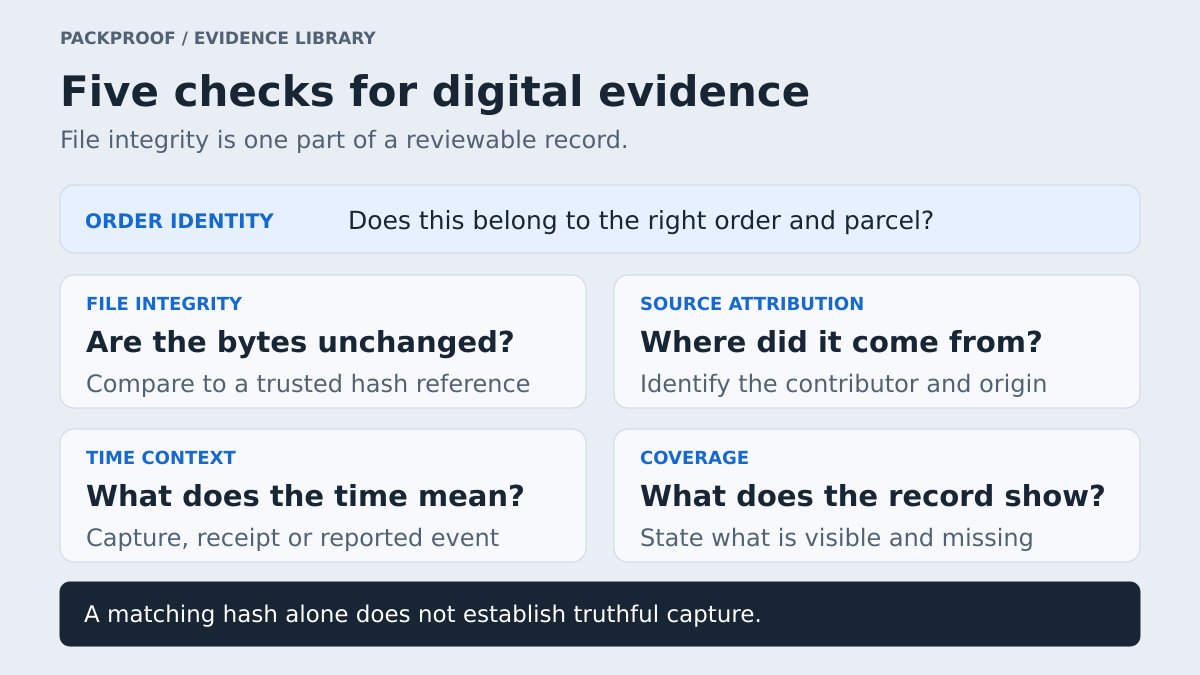
Diagram in words
Order identity connects material to the correct order and parcel. File integrity asks whether bytes match a trusted reference. Source attribution identifies the contributor and origin. Time context distinguishes a claimed capture time from service receipt time and a reported event time. Coverage states what is visible and missing. A matching hash alone does not establish authenticity, truthful capture, or events outside the recording.
Start with five questions
PackProof recommends evaluating a shipment record through five checks. These are practical review questions, not a certification standard or a score that decides a dispute.
| Check | Question | Useful information |
|---|---|---|
| Transaction identity | Does this material concern the order under review? | Order reference, item identifiers, parcel and tracking relationship |
| Source attribution | Who or what supplied this information? | Participant, carrier, system, source file, import method |
| File integrity | Does the retained file match its recorded reference? | Hash algorithm, reference digest, verification result, protected reference history |
| Chronology | What does each time value represent? | Device capture time, service receipt time, source event time, time zone |
| Coverage | Which parts of the physical event are visible? | Camera view, interruptions, first and last recorded moments, unknown intervals |
Weakness in one area does not automatically erase every useful observation. It changes the strength and scope of the conclusions a reviewer can draw.
File integrity asks whether the bytes match
SHA-256 is a cryptographic hash algorithm that produces a fixed-length digest from input data. For a file, the digest acts as a compact reference for a byte-level comparison. NIST's Secure Hash Standard describes using message digests to detect changes since the digests were generated.
A system can calculate a digest for a retained video and compare a later calculation against that reference. A matching SHA-256 result provides strong practical evidence that the compared bytes are the same, assuming the reference and implementation are trustworthy. It is not a mathematical guarantee that different inputs can never share a digest.
The reference must also be protected. Someone able to replace both the file and its recorded digest could make a later comparison appear consistent. NIST's Digital Evidence Preservation guidance discusses protected hash storage and the risk of changes before hashing or replacement of stored hashes. That publication addresses evidence handling; citing it does not certify a commerce product.
A matching hash does not validate the scene
The scope of a hash comparison is the data being compared. It does not determine whether the camera recorded the correct order, whether a scene was staged, whether an item was authentic, or whether the parcel stayed unchanged after recording stopped.
Consider a hypothetical recording created on Monday and first hashed on Thursday. A later matching digest supports consistency with the Thursday reference. The digest alone supplies no account of what happened before that reference was created. Recording a hash early can reduce that interval, but the process and its controls still need to be understood.
Similarly, a failed comparison means the bytes differ from the reference. It does not independently establish deliberate deception. A video export, recompression, metadata change, or file corruption can also change bytes. Identify the specific file and transformation before interpreting the result.
Preserve originals and identify derivatives
A still frame, thumbnail, compressed preview, and original recording are separate digital objects. Each can be useful, but a preview's integrity result should not be presented as verification of a different source file.
For review, label the source recording and locate extracted material within it. If a still illustrates the final seal at 02:14, preserve that relationship. If a file has been converted to meet an attachment requirement, identify it as a converted copy and retain the source where available.
This recommendation follows from a basic distinction: convenient presentation and preservation serve different purposes. A readable summary helps the reviewer navigate; the retained source lets the reviewer examine context omitted from the summary.
Attribution explains where a statement came from
A record may combine a seller's recording, the buyer's description, a carrier's status, and system-generated processing information. Label these origins wherever the information is presented.
“Buyer reports damaged corner” and “damage visible in buyer-submitted photograph” are related but different statements. “Carrier reports delivery” identifies the source of the status. “System received the file” describes a digital event. Keeping these labels prevents a mixed timeline from appearing to be one continuous independent observation.
Account attribution also has a limit. Identifying the account that submitted a file does not by itself establish who physically held the camera or controlled the parcel at every moment.
Explain timestamps before ordering events
A timestamp needs a meaning and a source. Device-reported capture time depends on the device's clock and capture process. A service receipt timestamp describes when the service received something. A carrier's event time belongs to the carrier's reporting process.
Display the time zone where known and avoid silently treating upload time as capture time. If an offline recording uploads later, the two times may be substantially different without that difference being evidence of misconduct. Where a precise chronology cannot be established, state the uncertainty.
Describe physical coverage explicitly
Digital preservation cannot expand what a camera saw. Ask whether the relevant identifier was readable, whether the item remained visible, whether the recording continued through the final seal, and when the camera stopped.
An evidence system may preserve a recording accurately while the recording leaves a critical corner of the item obscured. An append-only record may preserve all submitted statements while some statements conflict. Technical integrity and the sufficiency of evidence remain separate questions.
Before relying on a record, check the reviewable dispute record framework and the comparison of packing video and photographs. Examine a sample Proof, then review the reviewer workflow for the PackProof context. The strongest explanation of a record states both what can be checked and what remains unknown.
Sources
Technical sources reviewed September 26, 2026. The five-check framework and shipment examples are PackProof editorial analysis.
See the record in context.
Explore how PackProof connects the order, available evidence, and shipping activity.
See the reviewer workflow →