
Shipment Evidence: What Sellers Should Document Before an Order Leaves
A useful shipment record connects the order to the item shown, its visible condition, the packing process, and the sealed package. Keep the original capture alongside the order details and any later carrier records. Each source answers a different question; none should be made to stand for an event it did not observe.
Start before the item goes into opaque wrapping. Once the package is sealed, missing views of an identifier, included accessory, or pre-existing mark cannot be recreated as evidence of the earlier packing session.
Key points
- Connect the recorded item and package to one identifiable order.
- Capture condition, packing, and the final seal before those details become inaccessible.
- Keep seller recordings and carrier records clearly attributed to their sources.
- State what the record leaves unobserved, including events after recording ends.

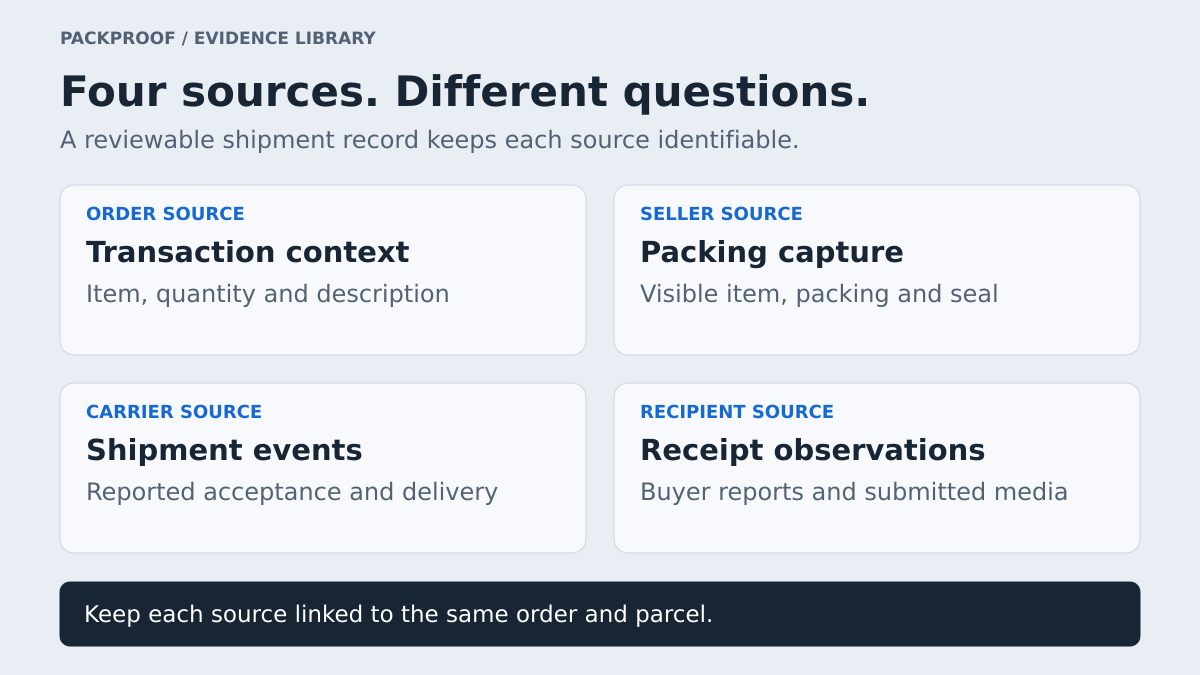
Diagram in words
Order records describe the item, quantity and transaction. Seller capture shows visible packing events. Carrier records report shipment events. Recipient submissions describe or show receipt observations. Link the sources to the same order and parcel while preserving who supplied each source.
Build the record around six questions
PackProof recommends the following inventory. It is a practical documentation framework, not a universal checklist imposed by carriers or marketplaces.
| Question | Useful source | What still needs care |
|---|---|---|
| Which transaction is this? | Order reference, listing, agreed contents | A similar product name may describe many different orders. |
| Which item is visible? | Readable serial, certification number, variant, or distinctive features | A visible identifier does not establish authenticity by itself. |
| What condition is shown? | Clear views of surfaces, known flaws, and relevant function | Unseen surfaces and untested functions remain unassessed. |
| How was it packed? | Continuous view of item placement, accessories, and protective materials | Hidden work and off-camera handling leave gaps. |
| Which package was closed? | Closure, final seal, and readable shipping reference | A label alone does not show what is inside. |
| What happened afterward? | Separately identified acceptance, tracking, delivery, or receipt records | A later status should not be described as part of the packing recording. |
This structure gives a reviewer a route through the material. It also makes an incomplete record easier to describe accurately.
Preserve the order context before you pack
Retain the version of the listing or order that describes the sale: item name, variation, quantity, included accessories, disclosed condition, and transaction reference. Save relevant messages when they change what is being supplied. A later edited listing may no longer describe the agreement at the time of the transaction.
Use one stable reference to connect this context with the capture. If an order has two parcels, identify which contents go into each parcel and retain both shipment references. Do not make a reviewer infer that relationship from filenames or identical boxes.
Keep invoices or other value documentation as a separate part of the record. For example, USPS's domestic claim guidance lists sales receipts and paid invoices among its forms of proof of value. A packing video serves a different purpose from that documentation.
Show identity and condition while they are accessible
Place the item in a clear workspace and confirm that the camera can resolve the details that matter. An identifier that is technically in frame but unreadable contributes little. Pause long enough for focus to settle, reduce reflections, and check a short test recording before the real session.
Show both the overall item and the relevant details. For a used camera, that might mean the body, serial, lens mount, included battery, and a disclosed scratch. For a graded comic, it might mean the certification label, front and back, and holder edges. The high-value collectibles guide explains those distinctions.
Describe observations precisely. “Display illuminates during the recorded power-on check” says more than “works perfectly.” The second statement covers functions that may never have been tested.
Keep the packing sequence understandable
Prepare your materials first so the item does not need to leave the recording area. Keep the item visible as you introduce protective materials, place it into the package, include accessories, and close the box. Show the final seal and the shipment reference attached to that package.
Continuity is useful only when the relevant actions are visible. A single uninterrupted video can still contain a long obstruction, unreadable label, or item carried out of frame. If that happens, keep the recording and describe the gap. If you reopen and repack, distinguish the first session from the later one rather than presenting either as the whole sequence.
For a format comparison, read what packing video and photos can show.
Example: one item, four sources
Consider an illustrative order for a used game console with one controller and a power cable. The listing records a scuff on the top panel. The packing video shows the console identifier, that scuff, the accessories, and the closing of the package. A drop-off receipt records a later carrier transaction. A buyer later submits a photo of the box as received.
Keep these as four attributed sources. The listing records what was offered; the video records what was visible during packing; the receipt records what its issuer reports; the buyer's photo records a separate observation. Their connection to the same order makes comparison possible without implying that one source verifies everything in the others.
Check the record before the package leaves
- Confirm that the order reference matches the intended transaction and parcel.
- Play the recording and check the identifier, condition views, item placement, closure, and label.
- Confirm that the capture has been saved successfully and is available to reopen.
- Retain originals when producing extracts or smaller copies for review.
- Add carrier records under their own source labels when available.
- Record any known gap while the session is still fresh in memory.
Limit unnecessary personal information in the workspace and review who can access the record. An address may be needed for a shipment review without belonging in a public social post. See evidence access and privacy before sharing.
What this record cannot establish
Packing evidence has a defined scope. It cannot independently establish everything that occurred after capture ended, who caused later damage, or whether an untested component functioned. A label and tracking number connect records; they do not create continuous observation of the package's journey.
If a question arises, organize the available material around the specific issue using the dispute evidence guide. A clear account includes both supported observations and unresolved intervals.
See the record in context
Explore the seller workflow and open a sample Proof to see how order context and shipment evidence can be presented for review. For more practical guides, visit Shipment Evidence.
Source reviewed
- USPS: File a domestic claim — consulted for the distinction between value documentation and shipment capture. Sources reviewed September 26, 2026. The capture workflow above is PackProof's recommendation.
See the record in context.
Explore how PackProof connects the order, available evidence, and shipping activity.
See the seller workflow →