
Packing Evidence for Trading Cards: Grading Labels, Serial Numbers, and Condition
Packing evidence for a trading card should connect the exact card or graded holder to the transaction, show the visible condition that can be recorded safely, preserve any certification information as an attributed source, and follow that item into the finished parcel. The most useful record is not the one with the most close-ups; it is the one in which every close-up can be matched to the correct card, holder, lot line, and shipment.
This guide covers shipment documentation. It does not grade or authenticate a card, determine market value, certify a holder, guarantee packaging performance, or decide a later claim.
Key points
- Treat card identity, visible condition, holder condition, and grading-service information as separate layers.
- Capture the front and back of the correct card or slab, then match close details to an overall view.
- Use a line-item ledger for lots so certification numbers, quantities, and parcel assignments do not drift apart.
- A readable certification number or database result does not by itself authenticate the physical card in the recording.

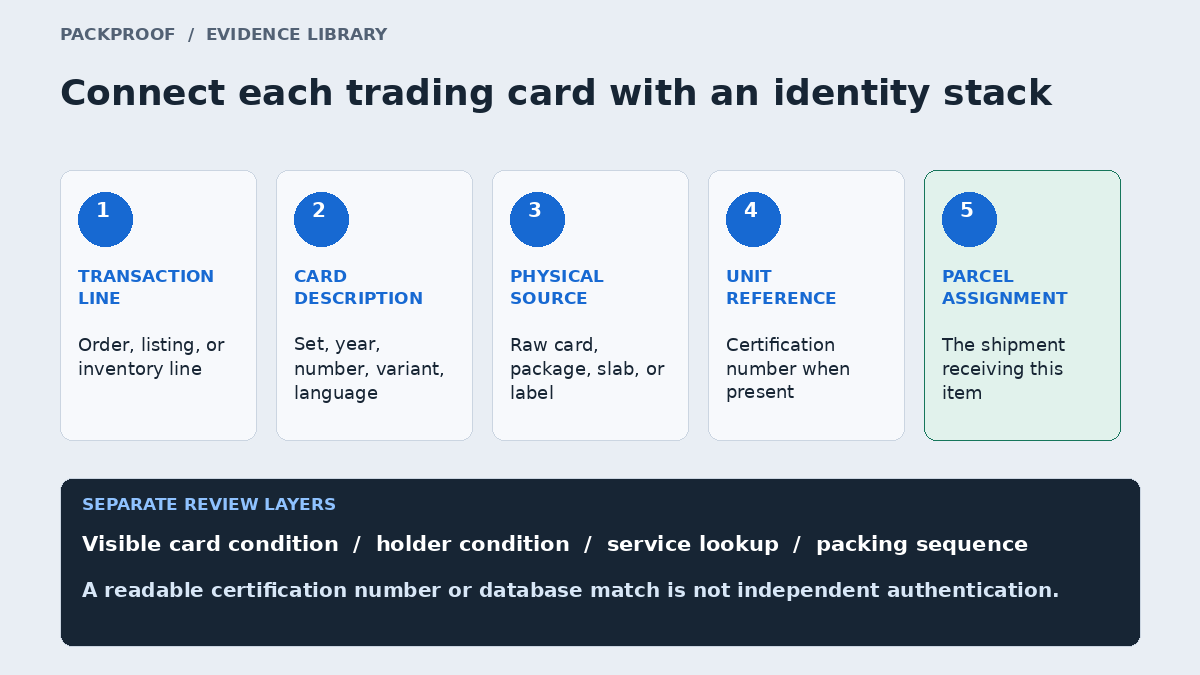
Diagram in words
A five-layer identity stack connects a trading-card shipment from transaction line to card description, physical card or label source, unit reference such as a certification number, and parcel assignment. Visible condition and packing are recorded alongside the stack; a certification match is not independent authentication.
Classify the card before choosing views
Raw and graded cards create different documentation questions. A lot or sealed product creates another set again.
| Item state | Identity to capture | Visible-condition focus | Important boundary |
|---|---|---|---|
| Raw card | Player or character, year or set, card number, variant or parallel, and transaction reference | Front and back, corners, edges, surface areas visible without risky handling | A sleeve, top loader, semi-rigid holder, or team bag may obscure a surface or edge |
| Graded card | Card description, grade as printed, certification number, grading service, and transaction reference | Slab front and back, label, holder surfaces, corners, edges, and visible card areas | Do not present the shipment record as a second grading or authentication event |
| Multi-card lot | Stable line reference, card identity, quantity, and group or parcel assignment | A consistent sequence for every card or declared subgroup | One group view rarely makes every identity and condition detail readable |
| Sealed product | Product name, set, edition, language, printed identifiers, and transaction reference | Visible outer packaging, factory seals or wrapping as seen, corners and disclosed marks | An exterior record does not observe the individual cards inside |
Choose one primary question for each item. For a graded card, it may be “Does the recorded slab and label match the sold item, and what visible holder condition was shown before packing?” For a raw card, it may be “Which card was packed, and which front, back, corner, edge, and surface views are actually available?”
Build the identity stack
Card identity often depends on several fields together. A player name alone may match hundreds of cards; a certification number alone may be copied or transcribed incorrectly. Use an identity stack:
- Transaction line: the order, listing, submission, or inventory reference.
- Card description: subject, set or year, card number, variant, parallel, language, or another relevant printed distinction.
- Physical source: the card, package, or grading label where the information is visible.
- Unit reference: certification number or another unit-level identifier where present.
- Parcel assignment: the particular shipment or package receiving the item.
Record the stack from overall to detail. Start with the card or slab in full view, show the identifying fields and unit reference, then return to context before moving to the next item. The identifier guide explains why a typed value, physical label, database response, transaction number, and tracking number should not be treated as interchangeable identifiers.
Separate the card, label, holder, and lookup
A graded-card record contains at least four distinguishable layers:
- the physical card visible inside the slab;
- the grading label and certification number attached to that slab;
- the outer holder and its visible condition; and
- any lookup result returned by the grading service.
The PSA certification tool can return card data for a PSA certification number. PSA also warns that number verification does not eliminate counterfeit risk and that genuine numbers can be copied. The CGC Cards verification tool returns description and grade information and may show service-created images for a certification number.
Attribute the result precisely: “PSA's database returned these fields for this number on October 31, 2026” is a source statement. “The card in this packing video is authentic because the number matched” goes beyond what a number lookup establishes. If a database image is available, keep it attributed to the service rather than presenting it as seller-captured shipment media.
Use a front–back–detail–context sequence
For one raw card or graded slab, a repeatable sequence reduces missing views:
- Front overall: hold the full card or slab in frame.
- Back overall: show the reverse without losing item continuity.
- Relevant details: record the specific corners, edges, surface area, label, number, or disclosed mark that matters.
- Context return: show the whole item again before it enters protection or before another card replaces it.
The sequence does not certify that every defect would be visible. Focus, resolution, compression, sleeve texture, glare, refractive patterns, dark surfaces, and the recording angle can all limit coverage. Describe what is clear, what is obscured, and what was not shown.
For raw cards, do not remove a card from protection solely to obtain a more dramatic close-up if doing so creates unnecessary risk. If the holder obscures an edge or surface, name that limit. For graded cards, distinguish a slab scratch, label issue, and visible card feature; the recording may not be able to resolve which layer contains a mark.
Control glare without breaking continuity
Glossy cards, foil treatments, sleeves, and slabs can turn the camera or light source into the main visible feature. Use diffuse room light where practical, adjust the angle rather than sweeping the card rapidly, and pause long enough for autofocus to settle. A tight detail should follow an overall view so the viewer can locate it on the correct card.
If different angles reveal different surface appearances, retain both rather than selecting only the more favorable one. Label an interpretation as an interpretation. “A line becomes visible near the top edge when the card is tilted” stays within the observation; “the line is definitely a print defect” may require specialist assessment beyond the packing record.
Review the saved media at normal playback and on a still frame before packing. The video-versus-photos guide explains why continuous footage and selected stills answer different questions and can complement each other.
Give lots and bundles a line-item ledger
Multi-card shipments are prone to identity drift. A quick fan of 20 cards may show that cards were present but still leave individual numbers, variants, quantities, and conditions unreadable. Use a ledger that mirrors the transaction.
| Line | Card reference | Unit reference | Quantity | Parcel | Capture status |
|---|---|---|---|---|---|
| 01 | 2024 Example Set #18, silver parallel | Raw; no certification number | 1 | A | Front/back recorded; lower edge partly obscured by sleeve |
| 02 | 1999 Example Set #07 | Certification ending 6134 | 1 | A | Slab front/back and label recorded |
| 03 | Example team lot, cards 41–49 | Inventory group G-03 | 9 | B | Count and fronts recorded; individual backs not recorded |
These entries are synthetic. In the actual restricted record, retain the complete identifiers and the real transaction reference. If the public version is redacted, preserve the unredacted source separately and label the public copy as a derivative.
When several similar slabs are packed, complete one item sequence before starting the next. When multiple cards enter one team bag or bundle, record the bundle count and the ledger lines it contains. When a lot is divided between parcels, make the parcel assignment explicit before sealing.
Follow the item into protection and the parcel
Prepare the chosen protective materials and outer package before capture. Show the identified card or slab entering its immediate protection, any grouped or rigid support, cushioning, and the outer parcel. Keep enough context to distinguish the card being packed from cards waiting elsewhere on the table.
There is no single universal packing method for every raw card, slab, sealed product, value, carrier, destination, or weather condition. Use the carrier's current requirements and qualified advice where the item warrants it. The evidence goal is to make the selected materials and placement reviewable—not to claim that the camera tested them.
Continue through the finished seal and shipment reference. If the recording stops before closure, a later photo of a sealed parcel is a separate observation; it does not restore the missing interval. If an item is removed and repacked, retain the original source and document the new sequence rather than silently replacing it.
Review the record by question, not by file count
Before dispatch, ask:
| Review question | Stronger coverage | Remaining limit to state |
|---|---|---|
| Which card is this? | Overall views plus readable set/card/variant details | Similar cards or obscured printed fields may remain unresolved |
| Which graded unit is shown? | Label and certification number connected to the whole slab | A number match does not independently authenticate the physical object |
| What visible condition was recorded? | Front, back, matched details, and holder-specific observations | Unshown, obscured, compressed, or inaccessible surfaces remain unknown |
| Which cards are in the lot? | Ledger lines, count, and parcel assignment | Group views may not document each individual back or surface |
| How was the item packed? | Continuous item-to-protection-to-parcel sequence | The camera does not test performance in transit |
| What happened later? | Separately attributed carrier and recipient sources | The outbound record does not observe custody, delivery, or opening |
The result should be a bounded, source-linked record. It can support comparison with a later receipt or return submission, but it cannot fill an unrecorded interval or decide why a difference exists.
Use the high-value collectibles cornerstone for the cross-category method, the comic-book guide for raw and slabbed comics, and the high-value shipment guide for the wider dispatch review. Browse Collectibles & High-Value Items or inspect a sample Proof to see how sources stay connected.
Sources and editorial scope
Sources reviewed October 31, 2026:
- PSA: Certification Verification — certification-number lookup and explicit warning that number verification does not eliminate counterfeit risk.
- CGC Cards: Verify Certification — certification-number lookup, returned description and grade, QR-code use, and service-created card images when available.
The identity stack, front–back–detail–context sequence, lot ledger, capture-status labels, and review matrix are PackProof editorial guidance. They do not grade or authenticate a card, determine value, certify packaging, or establish events after capture.
See the record in context.
Explore how PackProof connects the order, available evidence, and shipping activity.
Open a sample Proof →