
Packing Evidence for Comic Books: Condition, Slabs, and Shipment Prep
Useful packing evidence for a comic book should make five things easy to inspect: the particular book, the visible condition shown before packing, any slab or other enclosure, the protective packing sequence, and the finished parcel. The views change depending on whether the comic is raw or graded, but the basic discipline is the same: connect close details to an overall view and describe only what the record actually shows.
This is a shipment-documentation workflow, not a grading guide. It does not assign a grade, authenticate a comic, appraise it, or predict how a carrier, marketplace, insurer, buyer, grading service, or reviewer will decide a later issue.
Key points
- Decide whether the transaction concerns a raw comic, a graded comic, or a group of books before planning the views.
- Record item identity, visible condition, enclosure condition, and packing as separate observations.
- Use matched overall and detail views so a small defect remains connected to the correct book or slab.
- A certification lookup reports what the issuing service returns; it does not make the packing record an authentication or grading opinion.

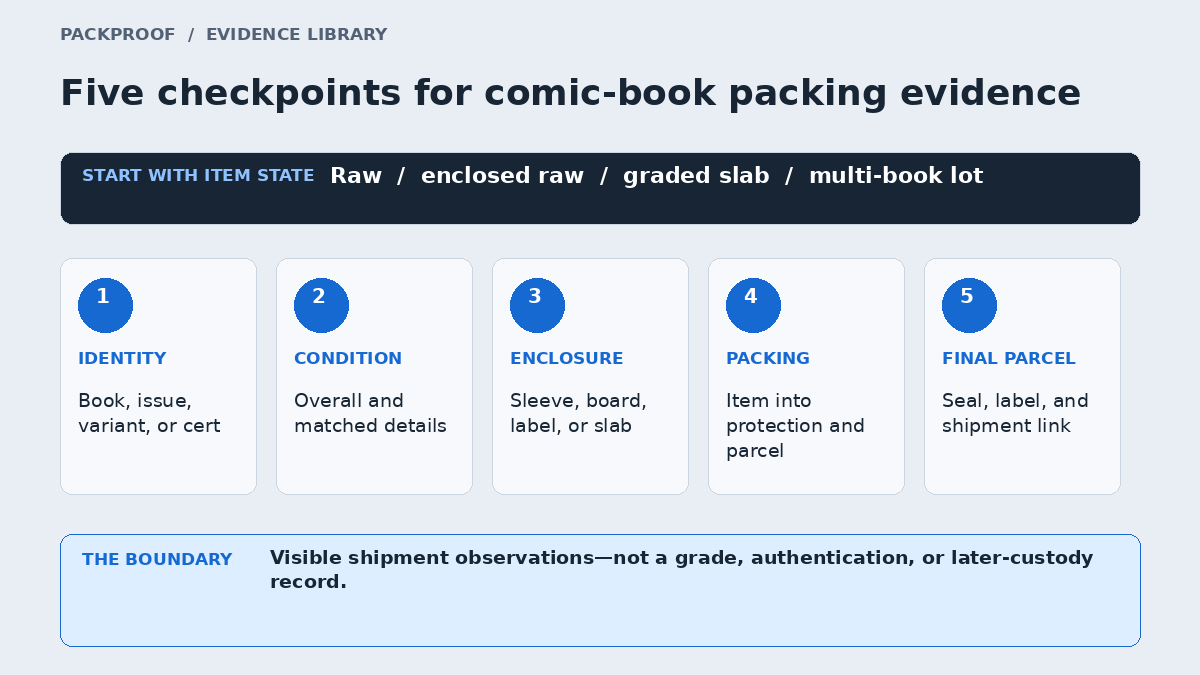
Diagram in words
Five connected comic-book shipment checkpoints: identify the raw or graded comic, record visible condition, separate comic condition from sleeve or slab condition, show packing, and connect the sealed parcel to the shipment. The sequence documents visible observations but does not grade or authenticate the comic.
Start by naming the item state
Before recording, identify which physical state is being packed. “Comic book” is not specific enough when the available surfaces and handling limits differ.
| Item state | Identity details to connect | Condition views to consider | Handling limit to preserve |
|---|---|---|---|
| Raw comic | Title, issue number, publisher, printing or variant details, and transaction reference | Front and back covers, spine, corners, edges, and any disclosed visible mark | Do not create new handling risk merely to expose every page or surface |
| Raw comic in a removable sleeve or board | The same book details plus the enclosure used for the shipment | Visible cover and edge views through the enclosure; separately record any enclosure mark that could be mistaken for a book defect | If removal is unsafe or unnecessary, state that the enclosure limits the view |
| Graded comic | Readable certification label, title and issue details, certification number, and transaction reference | Slab front and back, edges and corners, label, and any visible crack, chip, scuff, or separation | Do not open the slab; CGC says removal voids its certified grade |
| Multi-book lot | A count, a stable item reference for each book, and the parcel or bundle assignment | A repeatable overall/detail sequence for each book, followed by the completed group | Avoid a fast stack-through that leaves identities or counts ambiguous |
For raw books, the Library of Congress care guidance recommends clean hands and a clean work area, avoiding food and drink, and not opening a comic more than 180 degrees or folding it back on itself. Those are preservation considerations, not carrier packing instructions. Plan the capture so documenting the shipment does not require unnecessary flexing, tape near the comic, or repeated removal from its protective enclosure.
Use five connected checkpoints
The five-checkpoint model keeps separate questions from collapsing into a single “condition video.”
- Identity: Which book or slab is this, and which transaction or inventory line does it belong to?
- Visible condition: Which surfaces and details are actually clear in the saved media?
- Enclosure condition: Is a mark on the comic, inner well, sleeve, board, or outer slab?
- Packing sequence: How does the identified item enter its protective materials and parcel?
- Final parcel: Which closed, sealed, and labeled parcel contains the recorded item?
The checkpoints form a review path, not a quality score. A record can cover four checkpoints well and still have an honest gap at the fifth. State the gap instead of treating the whole record as complete.
Record identity before condition language
Begin with an overall view. Show the title and issue information available on the object or label, then connect the book to the order, listing, submission, or inventory reference. If a variant, printing, signature notation, pedigree, page-quality notation, or other label detail matters to the transaction, make it readable without interpreting beyond the source.
For a graded comic, record the certification number where it appears on the physical label. The CGC certification tool can return the description and grade associated with a number in CGC's database. Save the lookup result and review date as a separate service-source record. The physical label, the lookup response, and the seller's packing media are three different sources even when their text agrees.
CGC describes certification numbers, grades, descriptions, security features, and QR codes as label features. It also says opening a holder voids the certified grade. That makes the intact slab a handling boundary: document the visible comic and holder without presenting the packing session as an independent examination of the encapsulated book.
Capture condition as matched views
Use an overall → detail → overall sequence for a disclosed or notable feature:
- Hold an overall view long enough to establish the correct comic or slab.
- Move to a close view of the corner, spine area, cover mark, label, slab edge, or other relevant detail.
- Return to a wider view so the detail remains spatially connected to the item.
This sequence is especially useful where two defects could be confused—for example, a scuff on the slab surface and a color break visible on the comic beneath it. Use bounded descriptions such as “a short scuff is visible on the outer holder near the lower-left corner.” Avoid “mint,” “perfect,” “undamaged,” or another whole-object conclusion unless it is a properly attributed statement from the transaction or grading source.
Glare is a coverage problem, not a cosmetic nuisance. A reflection can hide a label digit, mimic a crease, or make a slab surface impossible to evaluate. Tilt the camera or light slightly, keep the whole item in context, and review the saved media before the book becomes inaccessible. Do not use harsh light or prolonged exposure merely to improve a recording; the Library of Congress recommends minimizing light exposure for comic-book preservation.
Keep the comic and its enclosure distinct
A raw comic, sleeve, backing board, inner holder, label, and slab can each have a different visible condition. Record which layer a statement concerns.
| Observation | Careful record language | Language to avoid |
|---|---|---|
| Mark appears on a removable sleeve | “A diagonal mark is visible on the outer sleeve in the recorded angle.” | “The cover is scratched.” |
| Slab corner is chipped | “A chip is visible on the lower-right outer holder corner before wrapping.” | “The comic is damaged.” |
| Comic detail is obscured | “The lower spine is not clearly visible through glare.” | “The spine is flawless.” |
| Database and label agree | “CGC's lookup returned the same issue and grade for the recorded certification number on October 31, 2026.” | “PackProof authenticated the slab.” |
If the layer cannot be resolved from the available view, preserve the uncertainty. A later reviewer may compare another angle, but the original record should not silently turn an ambiguous reflection into a condition finding.
Document packing without prescribing one universal method
Comic age, paper condition, slab design, declared value, carrier service, weather exposure, destination, and seller policy can change an appropriate packing method. Follow the carrier's current requirements and, for fragile or unusually valuable material, qualified preservation or shipping advice.
The evidence task is narrower: show the selected materials and the item's placement clearly enough to review later. Prepare materials before capture. Keep the item identity visible, then record the book or slab entering its immediate protection, any grouping or rigid support, cushioning and outer parcel, and the closure. If the item leaves the frame or a second item is added later, retain the available media and identify that gap.
For a multi-book lot, use a simple parcel inventory:
| Item reference | Item state | Distinguishing detail | Parcel assignment | Capture note |
|---|---|---|---|---|
| Lot line 01 | Raw, enclosed | Issue 12, cover A | Parcel A | Front and back visible through sleeve |
| Lot line 02 | Graded | Certification ending 2847 | Parcel A | Slab edge scuff shown before wrapping |
| Lot line 03 | Raw, enclosed | Issue 14, cover B | Parcel B | Lower spine obscured by enclosure glare |
These are synthetic examples. Keep complete references in the authorized transaction record and use deliberate redaction in any public derivative.
Finish at the parcel boundary
Continue the record through the final closure and shipment label. The finished view should connect the sealed parcel to the shipment reference without exposing a recipient's full address in a public copy.
The end of the recording is also a limit. It can show a comic entering protection and a parcel being sealed in view. It does not observe later custody, transit conditions, delivery, or opening. A carrier event or recipient submission belongs as a separately attributed source.
Before dispatch, replay the saved media and ask:
- Is the correct comic, issue, variant, or certification label readable?
- Can an overall view be matched to every important close-up?
- Are comic, sleeve, board, inner holder, and slab observations kept distinct?
- Is every item in a multi-book lot counted and assigned to a parcel?
- Does the visible packing sequence continue through the final sealed parcel?
- Are glare, inaccessible surfaces, camera gaps, and reported-only details stated honestly?
Use the broader collectible documentation guide for the cross-category framework, the identifier guide for certification-number handling, and the high-value shipment guide for the final dispatch review. Browse Collectibles & High-Value Items or inspect a sample Proof for the wider record structure.
Sources and editorial scope
Sources reviewed October 31, 2026:
- Library of Congress: Care, Handling, and Storage of Comic Books — handling, light, storage, and supportive-enclosure considerations for comic books.
- CGC: Verify Certification — certification-number lookup for description and grade.
- CGC: Holder & Label FAQs — holder, label, certification-number, QR-code, and holder-opening guidance.
The five-checkpoint model, matched-view sequence, language table, parcel inventory, and review questions are PackProof editorial guidance. They do not assign a grade, authenticate a comic, appraise it, certify packaging, or establish events after capture.
See the record in context.
Explore how PackProof connects the order, available evidence, and shipping activity.
Open a sample Proof →