
Damage Claims: Building a Source-by-Source Shipment Record
A useful shipping-damage claim record is not one large folder labeled “proof.” It is a source-by-source account of what was documented before shipping, what was observed after arrival, what physical material remains available, what the carrier reports, and how value or repair cost is supported.
Start by preserving the current state and checking the claim process that applies to the actual shipment. Carrier instructions differ, deadlines can be short, and an inspection may still be requested after photographs are submitted. Organizing the evidence helps a reviewer inspect the claim; it does not decide the outcome.
Key points
- Separate the outbound record, arrival observations, physical packaging, carrier events, and financial documents by source.
- Preserve the package, contents, and packaging while checking the current carrier process; photographs may not replace an inspection.
- Connect every file to the correct order, parcel, item, and claim reference before submitting it.
- A complete-looking packet does not establish when damage occurred or guarantee a claim outcome.

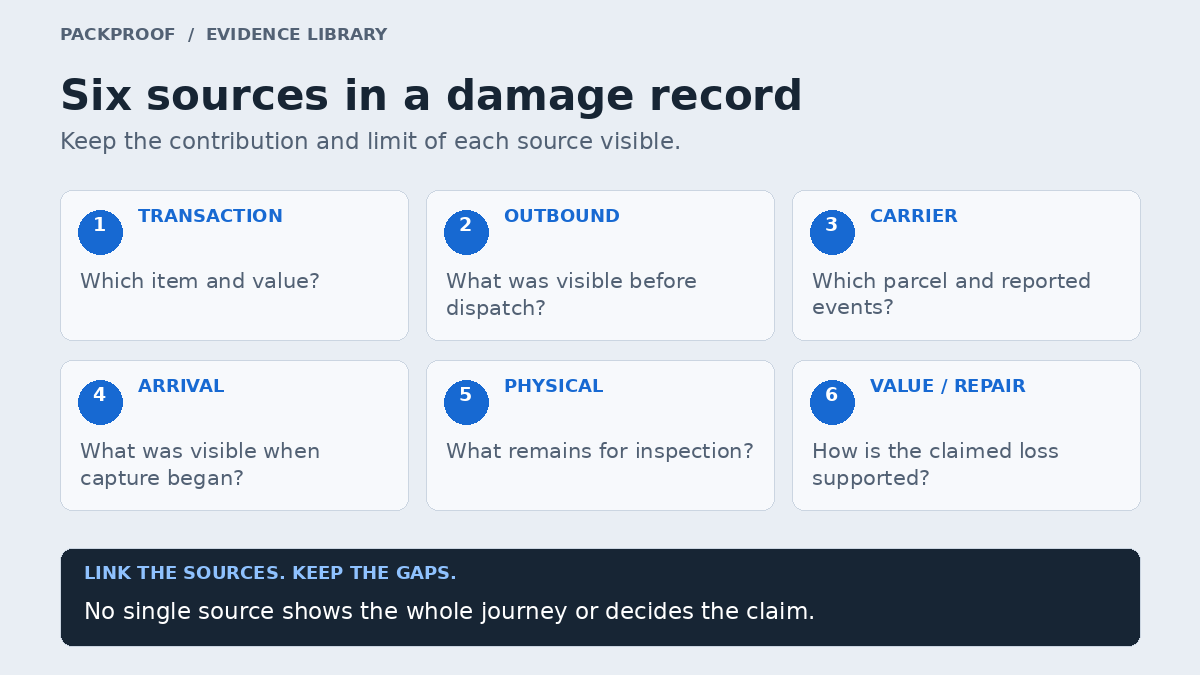
Diagram in words
Six separately attributed sources support a damage claim record: transaction context, outbound capture, carrier records, arrival capture, retained physical material, and value or repair documents. Each answers a different question. No single source establishes the whole journey or guarantees a claim outcome.
Stabilize the record before rearranging the package
If a parcel has arrived damaged, avoid discarding or unnecessarily changing the material that may be relevant. When safe and practical, retain the item, outer container, inner packaging, labels, and remaining contents. Record the parcel as encountered before removing tape, flattening the box, testing damaged equipment, or repacking it for storage.
Take an overall view first, then details. Show all accessible sides of the exterior, the shipping label in context, visible crushing or punctures, the closure, the inner packaging, and the damaged area of the item. A close-up can make a crack readable, while a wider view connects that crack to the item and package.
Do not create additional damage for a clearer image. If the item contains a swollen battery, broken glass, leaking liquid, or another hazard, follow the carrier or manufacturer's safety direction rather than continuing a normal handling sequence.
Build the record in six source lanes
PackProof recommends organizing a damage record by source rather than by whichever files look most persuasive.
| Source lane | Examples | Question it helps answer | Important limit |
|---|---|---|---|
| Transaction | Order, listing, invoice, item description | What item and value does the shipment concern? | Does not show physical condition or packing |
| Outbound capture | Condition views, identifier, packing sequence, final seal | What was visible before dispatch? | Does not observe later handling or arrival |
| Carrier record | Label, acceptance record, scans, claim reference | Which parcel and reported shipment events are involved? | A scan is not a continuous view of custody or condition |
| Arrival capture | Exterior, opening if recorded, contents, damage details | What was visible when receipt documentation began? | May not show the first opening or when damage occurred |
| Retained physical material | Item, box, cushioning, inserts, labels | What remains available for inspection? | Storage and later handling may affect condition |
| Value and repair | Receipt, paid invoice, appraisal, estimate, repair or non-repair statement | How are value and claimed loss described? | Does not establish the cause or timing of damage |
Give each entry a stable reference such as D01, D02, and D03. Record its contributor, original filename, relevant date context, and the question it addresses. If a still frame came from a longer recording, point to the recording and time position instead of presenting the still as an independent source.
Keep the outbound record separate from the arrival record
Outbound media may show that an item appeared intact in the recorded views, that cushioning was used, or that the parcel reached a visible sealed state. Describe only what can be inspected. “No crack is visible on the recorded front panel” is narrower and more reviewable than “the item was undamaged.” An unseen edge or untested component remains unobserved.
Arrival media begins at a later moment and from a different source. State whether the parcel was already open, whether the first opening was recorded, and whether the reported damage is visible. A comparison can identify a visible difference between two recorded states, but it cannot automatically locate the change within the unrecorded interval.
If the same serial number or other unit identifier is readable in both sets, note the match. Then compare like with like: the same corner, panel, holder edge, accessory list, or functional check. The identifier guide explains why item, order, and shipment numbers answer different questions.
Retain packaging because photographs may not end the process
Current U.S. carrier guidance illustrates why the physical parcel can matter after initial documentation:
- UPS's supporting-document guidance says damage claims require photo documentation and may require a physical inspection. Its listed photographs cover the damaged item with its internal packaging, the shipping label, and the package exterior; it also requests package dimensions.
- USPS domestic claim guidance says to save the original packaging and everything in the package until the claim is settled, not discard damaged items after photographing them, and be prepared for a possible Post Office inspection.
- FedEx's U.S. claims page identifies package and damaged-content photographs, serial numbers, value and repair documents, and inspection reports as examples of supporting material. It says to keep the original packaging and contents until the claim is resolved.
These are separate carrier processes, not a universal evidence standard. Follow the service, shipment type, declared-value terms, country, and case instructions that apply. Do not assume a marketplace return request pauses a carrier deadline, or that a carrier claim replaces a required marketplace response.
As reviewed October 17, 2026, USPS states that a damaged or missing-contents domestic claim may be filed immediately and no later than 60 days after mailing. FedEx states that damaged or missing-contents claims for U.S. packages must be filed within 60 calendar days of shipment, while its listed international parcel deadline is 21 calendar days. Verify the current page and the actual shipment terms before relying on those dates.
Connect value and repair evidence without overstating it
Value evidence and damage evidence perform different jobs. A sales receipt, paid invoice, completed transaction record, or appraisal can describe the item's value. A reputable repair estimate, repair invoice, or statement that an item cannot be repaired can describe the claimed loss. Neither source shows how the parcel was packed or when the damage occurred.
Preserve the document as received and identify its issuer. If the transaction used a discount, bundle price, replacement, or partial refund, keep that context rather than substituting a different retail price. Do not edit a repair document into a visual damage image; link the sources in the index instead.
Write a bounded claim summary
A concise cover note can make the packet easier to inspect:
Order R-318 concerns one camera body, serial ending 4726, shipped under tracking reference ending 9140. D01 is the order record. D02 is the seller's outbound recording; the serial is readable at 00:19, the front and side panels are visible, and the parcel is sealed at 02:04. D03 is the carrier event history. D04–D09 are recipient-supplied photographs of the exterior, internal packaging, and a cracked rear display. The first opening was not recorded. D10 is a repair estimate. The sources show two recorded states but do not establish when or why the display changed.
That summary identifies the shipment, locates the relevant observations, and states the main gap. It does not ask the reviewer to accept a conclusion before opening the sources.
Final submission check
- Confirm the order, item identifier, outbound label, and claim reference describe the same shipment.
- Preserve original files and identify excerpts, screenshots, or compressed copies as derivatives.
- Include the carrier's currently requested views and documents, not only the files already available.
- Retain physical material until the applicable process says it can be released or discarded.
- Record what was observed, reported, matched, or missing without assigning fault from an unrecorded interval.
- Save a copy of the submitted packet and any later requests for information.
For the broader organization method, read how to build a reviewable dispute record. The clear packing-recording guide covers the earlier outbound source, while the return-condition comparison guide addresses the separate return journey.
Sources and editorial scope
Official sources reviewed October 17, 2026:
The six-lane source model, index format, comparison language, and example are PackProof editorial guidance. Carrier requirements can change and may differ by service and location. This guide does not determine coverage, liability, causation, inspection sufficiency, value, or a claim outcome.
See the record in context.
Explore how PackProof connects the order, available evidence, and shipping activity.
See the reviewer workflow →