
Return Condition Disputes: Comparing Outbound and Return Evidence
A return-condition dispute should be approached as a comparison problem, not as a contest between two unlabeled sets of photographs. First confirm which item and transaction each source concerns. Then compare the same surfaces, accessories, functions, and packaging across separately attributed moments.
The result may show a match, a visible difference, a participant report, or a view that cannot be compared. That classification is useful even when the record cannot establish when a change occurred or who caused it.
Key points
- Confirm item identity before comparing condition, then align the same areas and tests where possible.
- Label each point as matching, visibly different, reported only, or not comparable; do not turn a missing view into a conclusion.
- Keep outbound packing, buyer receipt, return packing, carrier events, and seller receipt as separately attributed sources.
- A visible difference can support a condition comparison without establishing who caused it or when it arose.

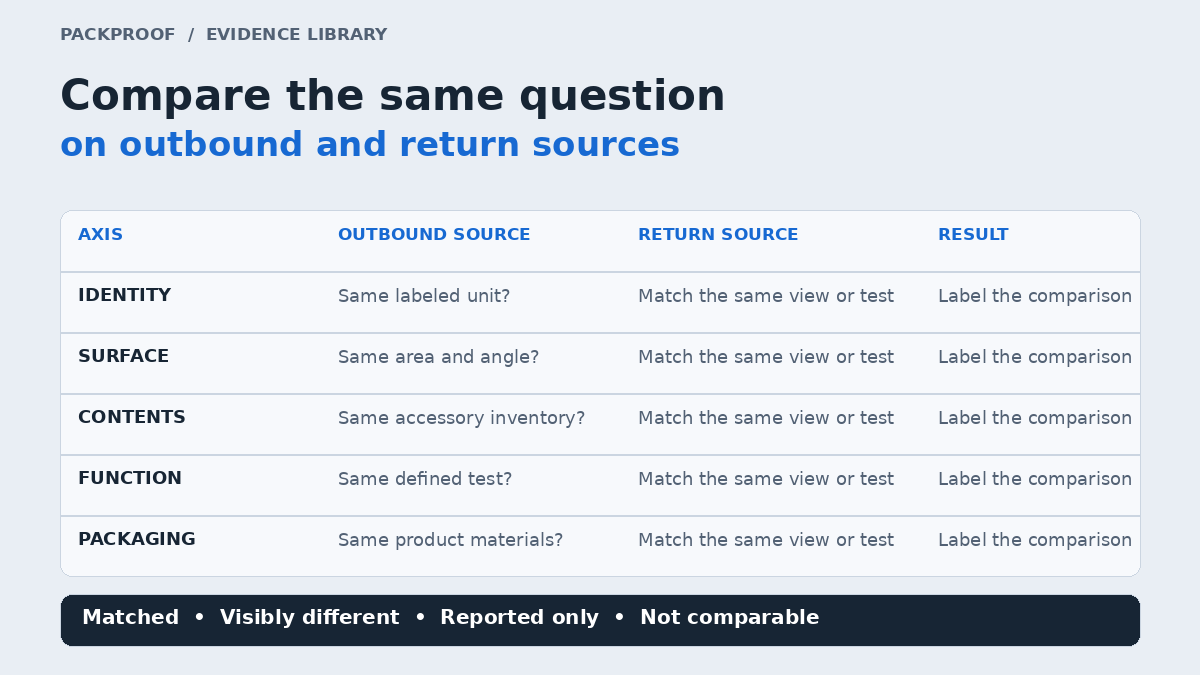
Diagram in words
A return comparison first confirms unit identity, then aligns the same whole-item view, condition area, accessories, functional test, and product packaging in outbound and return sources. Each point is labeled matched, visibly different, reported only, or not comparable. A visible difference does not identify cause.
Separate the journey into five sources
The word “return” can hide several distinct observation points:
- Seller outbound: the item, included parts, packing, final closure, and shipment reference before dispatch.
- Buyer receipt: the parcel and item as recorded when receipt documentation begins, including the first opening only if actually captured.
- Buyer return packing: the item and contents immediately before the return parcel is closed.
- Return carrier record: the separate return label, acceptance information, and reported shipment events.
- Seller return receipt: the returned parcel, opening if recorded, and inspection after it reaches the seller.
Keep the contributor and time context attached to each source. Do not splice seller and buyer recordings into one apparently continuous timeline. A summary can place them in order while still marking the intervals no source observes.
The broader return-evidence guide explains what to capture at each stage. This guide focuses on how to make the later comparison disciplined and reviewable.
Confirm identity before condition
Begin with the strongest available connection among the item, order, and return. That may include a serial number, IMEI, grading-label number, manufacturer marking, distinct visible feature, order reference, and return authorization. Use more than a detached close-up when possible: show the identifier in context on the whole item.
A matching model number identifies a product type, not necessarily one physical unit. A matching serial or certification number can connect labeled views of a unit, but it does not independently establish authenticity, ownership, or every aspect of condition. If no unit-level identifier exists, describe the weaker basis for comparison rather than silently treating two similar objects as the same.
Record discrepancies precisely. “Outbound source shows serial ending 4726; the return source shows 4276” is an observable mismatch. “The buyer swapped it” is a causal accusation the number alone does not establish.
Create a matched-view comparison grid
Compare defined areas and contents instead of relying on a general impression.
| Comparison axis | Outbound reference | Return reference | Status to record |
|---|---|---|---|
| Unit identity | Readable serial or item marker | Same field and context | Match, mismatch, unreadable, or absent |
| Whole-item view | Front/back or overall shape | Equivalent overall view | Comparable or different coverage |
| Condition area | Named corner, edge, screen, holder, seal | The same named area | Same visible state, visible difference, or not comparable |
| Accessories | Counted list in view | Counted list in view | Present, missing, added, or obscured |
| Functional state | Defined test and visible result | The same defined test | Same result, different result, reported only, or untested |
| Product packaging | Box, inserts, tags, certificates | Corresponding materials | Present, absent, changed, or not shown |
| Shipping preparation | Protective materials and closure | Return protective materials and closure | Separate outbound and return observations |
Use named locations: “lower-left corner when facing the display” is easier to match than “the side.” For reflective objects, slabs, screens, or glossy finishes, note glare and angle. A dark mark visible in one frame and hidden by reflection in another is not a clean condition difference.
Use four status labels consistently
For each comparison point, choose the most accurate status:
- Matched observation: the same identifier, accessory, feature, or state is readable in both sources.
- Visible difference: the same area is sufficiently covered and appears different between the two recorded states.
- Reported only: a participant describes a condition or function that is not visible in the supplied material.
- Not comparable: one view is missing, obscured, differently framed, or based on a different test.
“Not comparable” is not a failure of the entire record. It is a specific coverage finding. It may also identify a practical improvement for future capture, such as recording the underside of a case or using the same power-on test before both outbound and return packing.
Avoid scoring systems that convert these labels into a certainty percentage. The importance of a missing view depends on the actual issue. An unreadable serial may be central to an identity question, while it may be secondary to a clearly documented crushed outer box.
Keep function separate from visible condition
An item can appear unchanged while operating differently, or show cosmetic change while operating normally. Define a narrow, safe functional check when it is relevant and permitted: powering on to a specific screen, displaying a camera shutter count, confirming a controller connects, or showing that a button responds.
Use the same test on both sides when possible. If the outbound record shows only a power light and the return record includes a full diagnostic, write that the tests differ. Do not infer the earlier diagnostic result from the light. Do not run a test that could worsen damage, alter stored data, breach a seal, or conflict with the return process.
Participant statements still belong in the record. “Buyer reports intermittent shutdown” can sit beside “no repeated power-cycle test is available.” The first is a report; the second describes the coverage.
Compare accessories and packaging as inventories
List accessories individually rather than writing “all accessories included.” Cables, adapters, remotes, certificates, grading inserts, dust bags, manuals, and bonus items can be easy to overlook. Connect each item to a visible source or label it reported.
Keep product packaging distinct from shipping packaging. A manufacturer box, sealed retail wrap, or collectible holder may be part of the item's condition. The corrugated shipping carton and cushioning describe transport preparation. A change in one does not automatically establish a change in the other.
As one current marketplace example, eBay's condition of returned items policy states that an item should be returned in the condition received and include the items from the original package. Its general requirements discuss parts, accessories, product packaging, tags, labels, and accompanying materials, with additional category-specific requirements. That policy also describes circumstances in which some sellers might make a refund deduction. Read the actual transaction policy and return case; this article does not determine eligibility or a refund amount.
Example: a returned graded card holder
Suppose the outbound recording shows a graded card holder's front, label number, top edge, and both upper corners. The lower-right corner is outside the frame. The buyer's return-packing photographs show the same readable label number and a chip at the lower-right corner. The seller's receipt recording shows that chip again after opening the return parcel.
The identifier is a matched observation. The chip is visible in two return-side sources. The outbound-versus-return condition at that corner is not comparable because the outbound source did not cover it. The record does not establish that the chip arose during buyer possession or return transit.
If the outbound source had clearly shown that same corner without the chip, the pair could be labeled a visible difference between recorded states. Even then, the files would not continuously observe the interval or identify who caused the change.
Assemble the comparison packet
- Create a one-line issue statement without assigning fault.
- List the order, item identifiers, outbound shipment, return authorization, and return shipment.
- Index every source with its contributor, date context, and original filename.
- Add the comparison grid with time positions or image references for each matched view.
- Preserve originals and identify crops, annotations, or excerpts as derivatives.
- State unrecorded intervals, different tests, obscured areas, and missing accessories plainly.
- Submit through the applicable marketplace, carrier, payment, or merchant process within its current requirements.
The source-by-source damage-claim guide applies a similar discipline to carrier damage records. For the wider packet structure, use the reviewable dispute-record guide and inspect the PackProof buyer workflow.
Source and editorial scope
Official source reviewed October 17, 2026:
The five-source journey, matched-view grid, four status labels, and examples are PackProof editorial guidance. A condition comparison does not authenticate an item, establish uninterrupted custody, determine causation or fault, interpret a contract, or decide a carrier, marketplace, payment, or refund outcome.
See the record in context.
Explore how PackProof connects the order, available evidence, and shipping activity.
See how buyer participation works →