
How to Document a Graded Collectible Before Shipping
To document a graded collectible before shipping, connect six things without treating them as interchangeable: the transaction, the whole physical holder, the label and certification number, the grading service's current lookup result, the visible condition of the holder and enclosed collectible, and the packing sequence through the final parcel. The record should let a reviewer move between those sources while keeping each source's limits visible.
This workflow documents a shipment. It does not independently grade or authenticate the collectible, certify that a holder has never been opened, assign value, replace a grading service's current process, or establish what happens after the recording ends.
Key points
- Treat the physical collectible, holder, label, certification-service lookup, transaction, and parcel as distinct but connected sources.
- Record the whole holder before moving to readable label details and matched condition close-ups.
- Attribute lookup data to the grading service and capture when the query was performed; a number match is not a second physical inspection.
- Describe visible holder and collectible condition separately, and state what glare, sleeves, or the holder obscured.

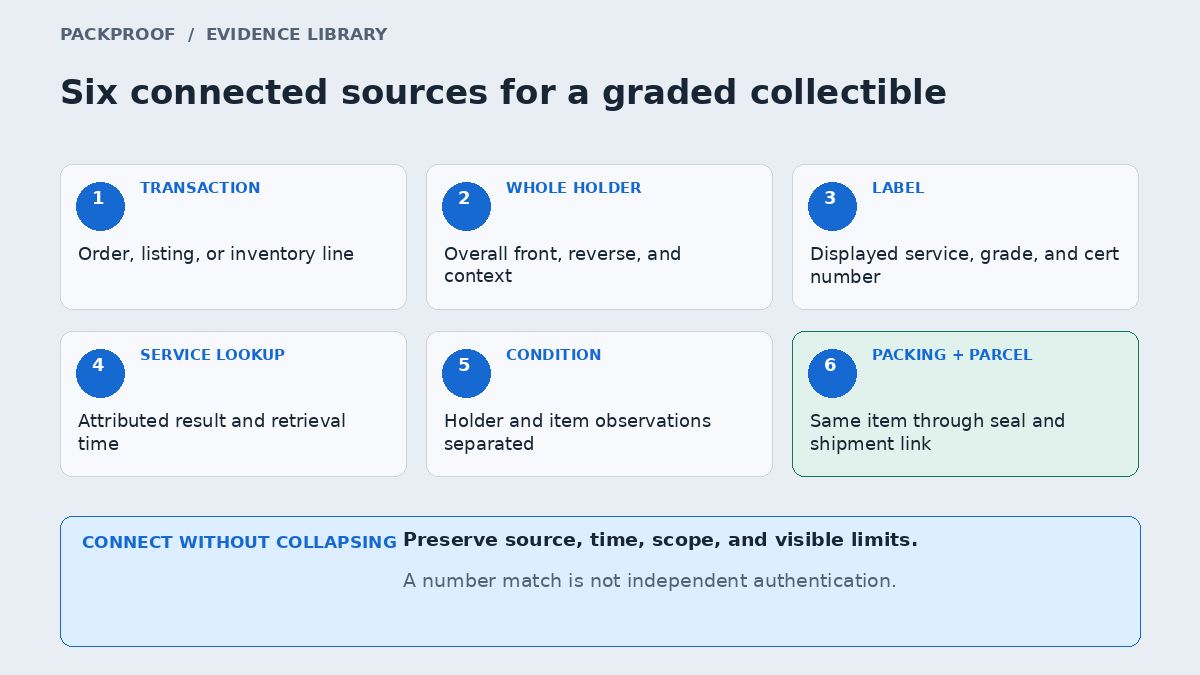
Diagram in words
Six connected but distinct sources for documenting a graded collectible shipment: the transaction record, whole physical holder, holder label, grading-service lookup, visible condition views, and packing through the final parcel. The connections support review without turning a number match or shipment recording into independent authentication.
Use a six-source record
A graded collectible arrives with more context than a raw item, but more context does not mean one source answers every question.
| Source | Question it can help answer | Important limit |
|---|---|---|
| Transaction record | Which listing, order, invoice line, or inventory entry is involved? | It does not show which physical object entered the parcel |
| Whole holder view | Which encapsulated object and holder are being recorded? | It may not make the label, surface marks, or edges readable |
| Holder label | What description, grade, certification number, qualifiers, or other printed fields are visible? | A readable label does not independently establish that the holder or enclosed object is genuine |
| Grading-service lookup | What data did the named service return for the queried number at that time? | It is a service-supplied database result, not a second inspection of the object in the recording |
| Condition views | Which holder and enclosed-item areas were visible in the recorded angles? | Glare, sleeves, holder optics, depth, and inaccessible surfaces can hide relevant detail |
| Packing and parcel record | How did the recorded holder enter protection and the finished shipment? | It does not observe later custody, delivery, opening, or return |
The value comes from the links between these sources. A close-up should remain traceable to the whole holder, the holder to the transaction, the lookup to the exact queried number, and the same item to the final parcel.
Start with the item state and transaction
Before recording, describe what is actually being shipped. “Graded collectible” may refer to a card, comic, ticket, autograph, video game, magazine, photograph, sealed pack, or another object. It may use a holder, label format, qualifier, or certification process that differs by service and era.
Record the transaction description as its own source. Include the order or inventory reference, promised collectible, grading service, displayed grade, certification number, and included extras only when those fields are part of the real transaction. Do not silently replace listing language with what a lookup returns; preserve both and compare them.
If the parcel contains multiple graded items, use a line-item ledger:
| Line | Transaction description | Service and certification reference | Parcel assignment | Capture status |
|---|---|---|---|---|
| 01 | Graded card from order line 2 | Service A; full number retained in restricted record | Carton 1 | Whole holder, label, condition, lookup, and packing recorded |
| 02 | Graded comic from order line 3 | Service B; final digits 1842 in public derivative | Carton 1 | Rear holder edge obscured by sleeve; limitation recorded |
| 03 | Graded ticket from order line 4 | Service A; lookup pending during capture | Carton 2 | Physical item and label recorded; lookup remains a separate pending source |
These are synthetic examples. Use the actual transaction fields and preserve complete private identifiers only in the authorized record.
Record the whole holder before label details
Begin with an overall front view that makes the holder and enclosed collectible recognizable. Move to the label, certification number, barcode or QR code where relevant, and other service-specific fields. Then return to the whole holder. Repeat the overall → detail → overall sequence for the reverse and for important edges or corners.
This pattern matters because a sharp label close-up can lose its connection to the physical object. The return to context shows which holder the detail belongs to without claiming uninterrupted custody beyond the recorded interval.
Do not force a service's current label features onto an older holder or a different collectible type. PSA's current security page describes its LightHouse label, QR-enabled certification access, holder design, and other PSA-specific features. CGC's holder and label FAQ describes CGC label fields, certification numbers, security features, QR access, and tamper-evident holders. Treat those as service sources, not as a universal checklist for every slab.
Avoid flexing, prying, tapping, opening, removing seals, or performing improvised “tamper tests” for the sake of a shipment recording. Record visible observations under ordinary safe handling. If the holder raises a concern, preserve the available record and use the grading service's current review or contact process.
Capture the service lookup as a separate source
Use the grading service's current official verification tool when a lookup is relevant. Record enough context for another reviewer to understand what happened:
- Name the service and official lookup URL.
- Record the date and approximate time of the query.
- Identify the certification number queried, keeping public-redaction needs in mind.
- Preserve the fields the service returned, including any warning, unavailable result, qualifier, description, grade, or service-created image.
- State whether the returned description appears consistent with the visible label and transaction.
- Keep the lookup capture attributed to the service rather than presenting it as seller-created physical evidence.
The PSA certification tool confirms database data associated with a certification number and expressly warns that certification-number verification does not eliminate counterfeit risk because real numbers can be copied. The CGC certification tool asks for a collectible type and certification number to return description and grade information; CGC describes the tool as a way to help verify the holder and check for tampering.
Preserve those service statements accurately. In a PackProof record, the bounded statement is: “PSA returned these fields for this queried number on November 14, 2026,” or “CGC returned this description and grade for this queried number.” Whether the physical object should be accepted as authentic remains outside PackProof's independent determination.
If the lookup does not match the label or transaction, do not diagnose the cause. Recheck the characters and collectible type, retain the original result, record the discrepancy, and consult the service's current process. A mismatch may reflect an entry error, a changed service record, a label issue, a wrong collectible selection, or another cause the shipment recording cannot resolve.
Separate holder condition from collectible condition
The holder and the enclosed collectible are different physical layers. A scratch on plastic may affect visibility without being a mark on the collectible. A visible corner issue inside the holder is not automatically damage to the holder. Record the two layers separately.
| Area | Prefer a bounded observation | Avoid an unsupported conclusion |
|---|---|---|
| Holder face | “Two linear marks were visible on the front plastic under side lighting” | “The card is scratched” when the marks may be on the holder |
| Holder edge or weld | “No opening was visible along the recorded top and right edges” | “The holder has never been opened” |
| Label | “The displayed service, grade, description, and certification number were readable” | “The label is genuine” based only on appearance |
| Enclosed collectible | “The recorded front showed the named corner and surface area through the holder” | “Perfect condition” or a new grade assigned from the shipment recording |
| Sleeve or outer bag | “The holder remained inside a fitted sleeve during the recording” | “The holder was flawless” when the sleeve obscured it |
Use diffuse light and slight angle changes to distinguish glare from a persistent visible mark. If a protective sleeve blocks an area, remove it only when ordinary handling is safe and appropriate; otherwise state that the area was obscured. The goal is a truthful visible-condition record, not a new grading session.
Keep service images and seller capture attributed
Some certification results include service-created images. Those can be useful comparison sources, but they were created by the service at another time and under another process. Keep them labeled with the service, certification number, retrieval time, and any available image context.
Do not merge a service image, listing photograph, seller packing video, and buyer receipt image into an unlabeled montage. A reviewer should be able to tell who supplied each image and when it entered the record. Differences in lighting, orientation, crop, resolution, holder state, or image processing can make an ordinary comparison look more certain than it is.
A comparison can identify a visible similarity or difference. It cannot fill an unrecorded interval or establish the cause of a change by itself.
Follow the same holder into the parcel
After identity, lookup, and condition views are complete, keep the recorded holder connected to the packing sequence. Use materials and handling appropriate to the actual collectible, holder, carrier service, and destination. This guide does not replace current packaging, insurance, hazardous-material, or service-specific requirements.
For a multi-item shipment, show which ledger line enters which inner protection and which parcel. Continue through closure, the final seal and shipment reference, then confirm the saved recording and parcel assignment before dispatch.
Before the item leaves, ask:
- Can a reviewer connect the transaction to the whole physical holder?
- Are label and certification details readable and returned to an overall view?
- Is the lookup attributed to the correct service, number, and retrieval time?
- Are the holder, label, enclosed collectible, and outer sleeve described separately?
- Are glare, obscured areas, unreadable fields, and unrecorded intervals stated?
- Does each line item remain connected to the correct final parcel?
- Are complete identifiers, addresses, barcodes, and account details controlled in public derivatives?
- Does the language stop at visible observations and attributed service data?
For category-specific capture, continue with the guides for trading cards and comic books. The high-value collectibles guide provides the broader identity-and-condition framework, and the identifier guide explains why product, unit, transaction, and shipment references should remain distinct.
Browse Collectibles & High-Value Items or inspect a sample Proof for the surrounding record structure.
Sources and editorial scope
Sources reviewed November 14, 2026:
- PSA: Cert Verification — official certification-number lookup, returned database context, and PSA's explicit warning that number verification does not eliminate counterfeit risk.
- PSA: Security — current PSA-specific label, holder, QR, imaging, and security-feature context.
- CGC: Verify Certification — current collectible-type selector and certification-number lookup for description and grade data.
- CGC: Holder and Label FAQs — current CGC-specific holder, label, certification-number, QR, and tamper-evident context.
The six-source model, line-item ledger, overall–detail–overall sequence, lookup capture fields, condition-language matrix, attribution workflow, and dispatch questions are PackProof editorial guidance. They do not independently grade or authenticate a collectible, determine value, guarantee a grading-service or claim outcome, certify a holder as untouched, or establish events after capture.
See the record in context.
Explore how PackProof connects the order, available evidence, and shipping activity.
Open a sample Proof →