
How Fulfillment Teams Can Standardize Packing Evidence
Fulfillment teams can standardize packing evidence by defining a capture contract: when a record is required, which identities must be bound, which questions the record must answer, how closure is documented, how exceptions are labeled, who reviews the result, and how the source is retained. The standard should produce consistent answers without forcing every order into the same footage length or physical motion.
This is an operational framework, not a claim that every shipment needs video or that one capture method satisfies every carrier, customer, regulator, insurer, marketplace, or internal policy. Start with the operation's real shipment questions and the systems already in use.
Key points
- Standardize the questions and record fields, not an arbitrary video length or identical motion at every station.
- Bind the capture to the order, item or handling unit, operator or system source, station, and parcel before closure.
- Use explicit exception codes for incomplete or atypical captures instead of hiding gaps or forcing false completion.
- Measure review time, retrievability, exception quality, and source coverage before expanding the workflow.

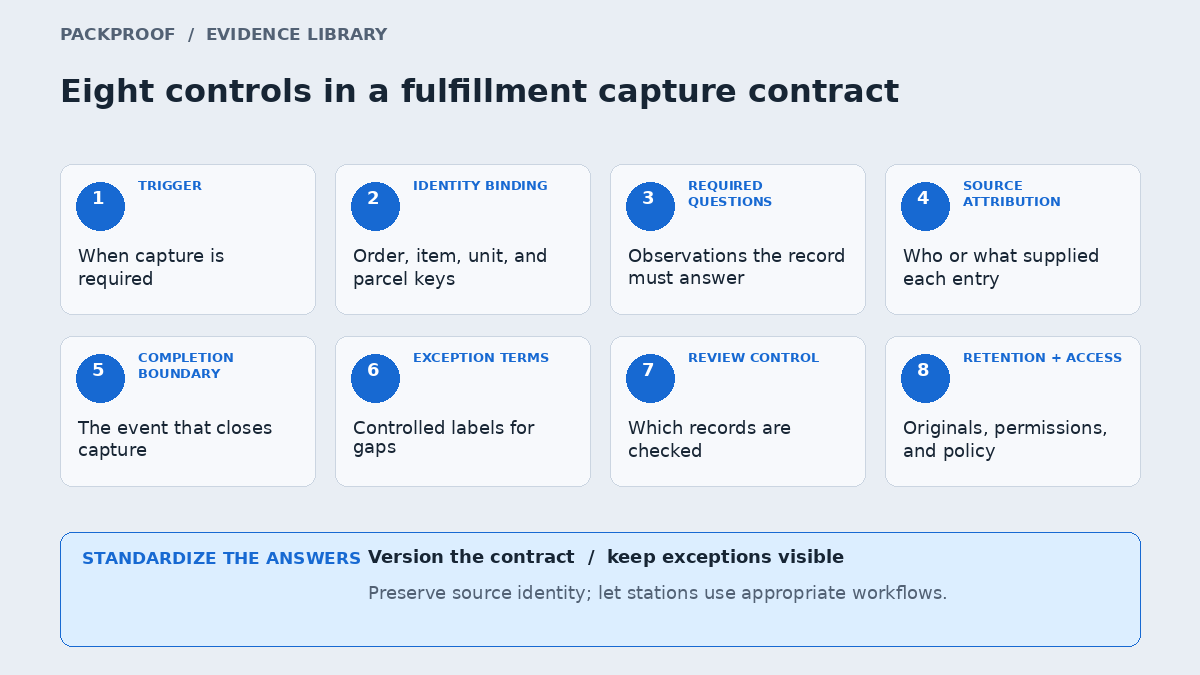
Diagram in words
A fulfillment capture contract defines eight controls: trigger, identity binding, required questions, source attribution, completion boundary, exception vocabulary, review control, and retention and access. The contract standardizes reviewable answers while allowing stations and shipment classes to use appropriate workflows.
Standardize questions before camera motions
A script that says “record for 45 seconds” is easy to audit but may still miss the device serial, quantity, final seal, or correct parcel. A better standard names the questions a reviewable record must answer:
- Which order, handling unit, parcel, and item lines does this capture concern?
- Which source, station, operator role, device, or automated system produced it?
- Which item identity, quantity, and visible condition observations are required for this shipment class?
- Which components or accessories must be counted or individually identified?
- Which packing and closure observations must remain visible?
- Which later shipment reference is bound to the finished parcel?
- Which gaps, substitutions, interruptions, or overrides occurred?
- Where are the original source and its reviewable metadata retained?
Different workstations can answer these questions with different hardware or layouts. The consistent output is the source-linked record, not a performance of identical hand movements.
Define the capture contract
The capture contract is a versioned operating specification for one shipment class. It should be readable by fulfillment leads, trainers, system owners, reviewers, and integration teams.
| Control | Required definition | Example |
|---|---|---|
| Trigger | Which orders or events require capture | All serialized devices; high-value threshold; customer-program requirement; random quality sample |
| Identity binding | Which existing references connect the record | Order line, tote, carton, SSCC, parcel label, return authorization, work cell |
| Required questions | Which observations must be reviewable | Item/quantity, visible condition checkpoint, accessory count, placement, closure, label |
| Source attribution | Who or what supplied each entry | Station camera, handheld scan, operator note, WMS event, scale, receiving submission |
| Completion boundary | What event closes the capture | Final seal plus label; container handoff; system confirmation after saved-file check |
| Exception vocabulary | How incomplete or atypical states are recorded | Identifier unreadable; camera interrupted; item substituted; parcel reassigned; capture not required |
| Review control | Which records are checked and by whom | All exceptions plus a defined sample of completed records |
| Retention and access | Where originals, derivatives, logs, and permissions live | Restricted source retained; review copy linked; approved roles; policy-defined retention |
Version the contract. When a required view, identifier, or exception code changes, retain which version governed each record. That lets a reviewer distinguish an operator deviation from a later process change.
Reuse existing operational identifiers
Do not invent a new label if the operation already has a stable order, item, carton, pallet, tote, shipment, or handling-unit reference. Map the evidence record to those identifiers and preserve their scope.
GS1 defines a logistic unit as a combination of trade items or other objects established for transport or warehousing, and identifies it with an SSCC. Where an operation already uses SSCCs, that value can be one existing key for binding a record to the physical logistics unit. It does not replace the order line, item serial, shipment, source, or parcel observations.
Keep the levels distinct:
| Identity level | Operational question | Common mistake |
|---|---|---|
| Order or transaction | Which commercial request is being fulfilled? | Treating the order number as physical identification of every item |
| Item or component | Which product or unit is shown? | Recording only a SKU when a serialized unit matters |
| Handling or logistics unit | Which tote, carton, pallet, or container groups the goods? | Reusing a local container code without a time/version boundary |
| Shipment or parcel | Which carrier movement or label is involved? | Assuming a tracking number reveals the package contents |
| Evidence source | Which station, person, device, or system supplied the observation? | Merging camera, WMS, scale, and receiving entries into one unlabeled narrative |
The goal is not to maximize identifiers. It is to connect the minimum set that lets a reviewer move from order to item to handling unit to shipment to source without guessing.
Use shipment classes instead of one universal checklist
A single workflow for every order creates either excessive work or weak coverage. Group shipments by the questions that materially differ.
| Shipment class | Additional evidence question | Possible requirement |
|---|---|---|
| Standard non-serialized item | Was the correct item and quantity placed in the parcel? | Product/quantity view plus packing and final parcel |
| Serialized electronics | Which exact unit and accessories were packed? | Unit identifier, accessory ledger, bounded operation where relevant |
| Fragile or condition-sensitive item | Which condition areas and protective steps were visible? | Matched condition views plus item-specific placement |
| Multi-carton order | Which lines and quantities went into each carton? | Carton assignment ledger and one closure boundary per carton |
| Pallet or logistics unit | Which cases or cartons formed the unit, and which label identifies it? | Count/aggregation record, handling-unit identifier, wrap/seal boundary |
| Return or reverse movement | Which source covers receipt, inspection, repacking, and return dispatch? | Separate receipt and return sources linked to the original transaction |
Classes should remain few enough to train and maintain. Create a new class only when it changes the required questions, evidence source, operational risk, or review path.
Design the station around readable evidence
The physical station should make the required observations easy during normal work:
- Place the primary camera or sensor where it can see the item, work area, and parcel without frequent repositioning.
- Keep identifiers readable without forcing unsafe lifting, disassembly, or exposure of unnecessary personal data.
- Make the order or work reference available at the point of capture.
- Prepare standard materials before the capture begins so the item does not leave the recorded area unnecessarily.
- Reserve space for accessories or line items awaiting capture so they are not confused with completed items.
- Confirm that the record saved and remained associated with the intended order before the parcel leaves the station.
Test the station with representative items, not only the easiest package. Glare, dark housings, deep cartons, tall products, multiple cartons, and small labels can reveal coverage problems. A training example should include at least one honest exception rather than showing only a perfect sequence.
The clear recording guide covers focus, framing, continuity, and playback checks. The coverage guide turns the result into six review questions rather than a vague completeness claim.
Give exceptions their own vocabulary
An incomplete record should not be forced into “complete” merely to keep a metric green. Use a small, controlled exception vocabulary.
| Exception code | Meaning | Required follow-up |
|---|---|---|
| ID-UNREADABLE | Required identifier is present but not readable in the saved source | Retake before packing if safe; otherwise retain source and record the alternative identity evidence |
| CAPTURE-INTERRUPTED | A required interval was not recorded | Preserve available segments; identify the missing interval; do not describe it as continuous |
| ITEM-SUBSTITUTED | The expected item or unit changed during fulfillment | Bind the replacement identity and reason source; restart affected checkpoints |
| PARCEL-REASSIGNED | Items moved to another carton or shipment | Update the line-to-parcel ledger and record the new closure boundary |
| SOURCE-DELAYED | An external system event has not arrived by review time | Keep the event pending rather than converting absence into a failure |
| OVERRIDE-AUTHORIZED | A named operational role approved a documented deviation | Retain the approval source, reason, scope, and time; do not erase the original exception |
These labels are illustrative. Use terms that match the operation and avoid codes that assign blame or claim fraud. The exception should tell the next reviewer what is missing and what source could clarify it.
Review the process, not only individual recordings
Quality review should ask whether the standard helps answer real shipment questions.
Use three review groups:
- All exception records: confirm that the gap is visible, correctly labeled, and routed.
- A defined sample of completed records: check identity binding, readability, required questions, closure, and retrieval.
- Triggered review: inspect records associated with a complaint, discrepancy, station change, training issue, or repeated exception pattern.
Avoid one opaque “evidence score.” A single number can hide the difference between an unreadable serial, a missing closure interval, a late carrier event, and an accessory-count mismatch. Report the controls separately.
Useful operational measures include:
- Time to retrieve the record for a known order or parcel.
- Time to locate the source behind a quantity, identity, or condition observation.
- Percentage of required identity bindings present by shipment class.
- Exceptions by code, station, workflow version, and resolution state.
- Percentage of sampled records where required questions were readable.
- Rework created by capture problems.
- Time to prepare an internal or external review packet.
- Sources that arrive late or cannot be connected reliably.
These measures describe the workflow. They do not prove that an operation prevented loss, won claims, or caused a business outcome without a suitable evaluation design.
Pilot on historical and live samples
Start with a bounded shipment class and representative historical records. Map the available order, WMS, scan, camera, scale, label, carrier, and receiving sources. Time how long the current review takes, then compare the connected workflow against the same questions.
Move to a small live sample only after the identity mapping, permissions, exception vocabulary, and retention path are clear. Include ordinary completions, multi-parcel orders, substitutions, interrupted captures, and delayed sources. Train supervisors on review and escalation, not only operators on capture.
The logistics evidence record preview shows how order, item, journey, evidence, and history views can stay connected while source differences remain visible. The source-linked record guide explains the fields needed to move from a summary back to the retained source.
What standardization should produce
A mature packing-evidence process should make the same core questions answerable across people, shifts, stations, and systems. It should also make incomplete coverage obvious. Standardization is successful when a reviewer can retrieve the right record, inspect the source, understand the exception, and state the remaining unknowns without reconstructing the entire workflow from memory.
Browse Fulfillment Operations for related guidance, or review PackProof's integration model for order-linked records, source ingestion, permissions, and workflow design.
Sources and editorial scope
Source reviewed November 7, 2026:
- GS1: What is a logistics unit and how is it identified? — current logistics-unit and SSCC identification context.
The capture contract, shipment classes, identity-level matrix, exception vocabulary, review groups, metrics, and pilot sequence are PackProof editorial guidance. They are not a universal compliance standard, carrier requirement, guarantee of claim outcomes, or assertion that video is required for every shipment.
See the record in context.
Explore how PackProof connects the order, available evidence, and shipping activity.
Review the integration model →