
Shipment Evidence Inventory Matrix: What Each Source Can and Cannot Show
A shipment evidence inventory is a source-by-source index of the material available for one order journey. It records where each entry came from, which order, item, parcel, or return it concerns, what question it may help answer, and what remains outside its coverage. Build the inventory before writing a chronology or conclusion so that the organization of the record does not erase the differences between sources.
The matrix below is PackProof editorial guidance, not a universal carrier, marketplace, insurer, or legal requirement. A fuller inventory can make a record easier to inspect. It cannot turn an unavailable observation into a recorded fact or guarantee an outcome.
Key points
- Inventory each source before arranging the record into a chronology or summary.
- Record who or what supplied the source, which object it concerns, what its time means, and how it connects to the order, item, parcel, or return.
- State what each source can help answer and what remains outside its coverage.
- Keep originals, derivatives, participant reports, external events, and reviewer conclusions visibly distinct.

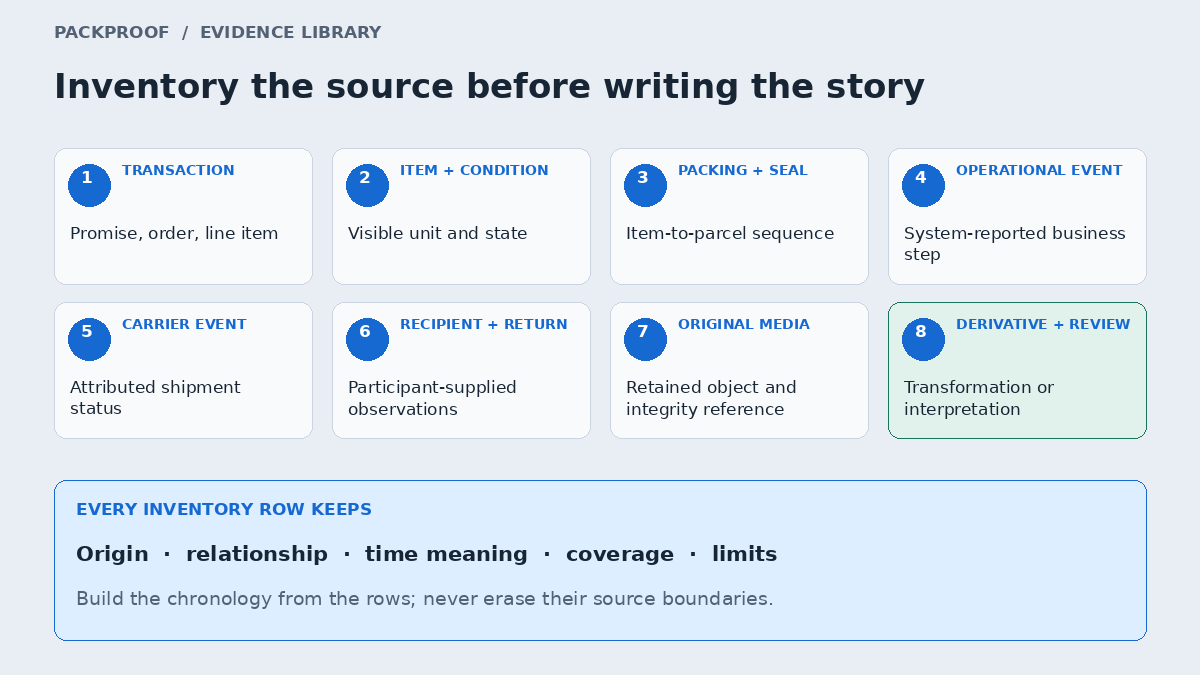
Diagram in words
Eight source classes in a shipment evidence inventory: transaction context, item and condition capture, packing and closure, operational events, carrier events, recipient and return submissions, original media, and review derivatives. Each row records origin, relationship, time meaning, coverage, and limits before a chronology is written.
Start with the source, not the story
An order database, packing video, tracking page, recipient photograph, return scan, certification lookup, and reviewer note may all concern the same shipment. They are not interchangeable.
Before asking what happened, ask four smaller questions:
- What is the source object? Identify the file, database row, status response, message, physical material, or human-created note.
- Who or what supplied it? Name the participant, device, carrier, service, warehouse system, or reviewer where known.
- What relationship is recorded? Link the source to the relevant order, line item, unit, parcel, tracking reference, delivery, or return.
- What can the source actually cover? Describe the visible or reported interval and its limits without borrowing certainty from another source.
The W3C PROV model distinguishes entities, activities, and agents and supports relationships such as generation, derivation, attribution, and use. PackProof does not require PROV-O for an ordinary shipment record, but the separation is useful: the file, the event it depicts, the person or system that supplied it, and a later derivative are different things.
Use the evidence inventory matrix
This matrix is a durable starting point. Add a row only when the source class is relevant to the actual order.
| Source class | Examples | Question it can help answer | What it cannot establish by itself | Minimum link fields |
|---|---|---|---|---|
| Transaction and promise | Order, listing, invoice, purchase record, agreed contents | What transaction, item description, quantity, price, or stated condition is under review? | Which physical unit entered the parcel or its later condition | Order ID, line item, source system, record time or version |
| Item identity and condition capture | Overall views, serial label, certification label, accessory count, function check | Which visible item or unit was recorded, and what condition or included parts were visible? | Authenticity, hidden condition, untested function, or later custody | Source file, contributor or device, item or unit ID, playback location, capture scope |
| Packing and closure capture | Placement sequence, cushioning, inner package, final seal, parcel label | How did the recorded item enter the recorded parcel, and what closure was visible? | Carrier acceptance, uninterrupted custody, delivery, or receipt contents | Source file, order and item links, parcel or tracking link, first and last covered moments |
| Warehouse or business-system event | Pick, pack, weigh, stage, load, ship, exception, receipt | What event did the named system record for which object or business step? | The physical scene unless the event links to separate capture; universal accuracy across systems | System, event ID, object ID, event time meaning, business step, location where appropriate |
| Carrier or logistics event | Label created, accepted, in transit, attempted, delivered, exception | What status did the named service report for the shipment at that time? | Contents, internal condition, every custody transfer, or a physical inspection not stated by the source | Carrier or provider, tracking reference, status text or code, event time, retrieval time |
| Recipient submission | Arrival photograph, opening video, condition description, message | What did the recipient submit or report about receipt and the visible parcel or item? | Every event before capture, an unrecorded opening interval, or the cause of a difference | Participant or submission source, service receipt time, parcel and item links, original files, stated limits |
| Return evidence | Return authorization, pre-return condition capture, return label, carrier events, receipt capture | Which item and parcel were documented for the return, and what was visible before and after return transit? | Continuous observation between outbound, receipt, return dispatch, and return receipt | Return ID, item or unit ID, outbound and return parcel links, contributor, stage, source time |
| External service lookup | Certification result, device-support lookup, repair estimate, carrier claim response | What did the named service return for the specific query or case at that time? | A new inspection by PackProof, universal authenticity, or facts beyond the service's stated scope | Service and URL, query or case reference, retrieval time, returned fields, warning or limitation |
| Original media and integrity record | Original video, original image, manifest, hash reference, storage receipt | Which retained object is the source, and does it match a recorded byte-level reference? | Truthful capture, authenticity of the scene, or events outside the file | Object ID, filename and format, receipt time, contributor, hash algorithm and reference where used |
| Derivative or review work | Thumbnail, extracted frame, crop, redaction, transcript, comparison, reviewer note | How was a source transformed, summarized, or interpreted for review? | A second original, independent observation, or a fact not present in the linked sources | Derivative ID, source object, transformation, creator or system, creation time, conclusion label |
The strength of the record comes from the joins. A packing video should link to the correct item and parcel. A carrier event should link to that parcel without being described as a view of its contents. A recipient photograph should link to the submission and retained original rather than appearing as an unattributed image in a collage.
Give every inventory row seven review fields
PackProof recommends seven fields for every source row. They form a compact source card even when the underlying systems use different schemas.
| Field | Record | Why it matters |
|---|---|---|
| Source identity | Stable entry ID and source class | Keeps similarly named files or repeated statuses distinguishable |
| Origin | Contributor, device, organization, or system; submission path when known | Separates who created information from who later uploaded or reviewed it |
| Object | Original file, database record, message, physical material, lookup result, or derivative | Makes clear what the inventory row actually describes |
| Relationship | Order, line item, unit, parcel, tracking, delivery, claim, or return link and the basis for that link | Prevents folder proximity from becoming the only association |
| Time meaning | Event time, device-reported capture time, service receipt time, retrieval time, or reviewer creation time with offset where available | Stops different clocks from becoming one unsupported chronology |
| Coverage | Visible or reported subject, interval, surfaces, fields, and business step | States the question the source may help answer |
| Limits and status | Unknowns, obscured details, conflicts, expected-but-unavailable sources, derivatives, access limits, or retention notes | Keeps gaps and uncertainty inspectable |
The GS1 EPCIS 2.0.1 standard is designed so disparate applications can create and share visibility-event data about identified objects in business context. It distinguishes event fields such as event time, business step, location, object identifiers, and record time. PackProof's inventory is not an assertion of EPCIS conformance; EPCIS is a useful example of why object identity, event meaning, and system context should remain explicit when data comes from multiple operational systems.
Keep original media and derivatives connected
An extracted still may make a serial number easier to read. A redacted copy may be safer to share. A transcript may make a spoken identifier searchable. Those are useful review objects, but they are not additional independent observations.
For each derivative:
- Link it to the retained source object.
- Record the operation: frame extraction, crop, resize, redaction, transcription, annotation, comparison, or export.
- Record who or what created it and when.
- Preserve the original separately when the retention policy and access authority permit.
- State any information removed or obscured in the derivative.
NIST IR 8387 describes the distinct preservation challenges of digital evidence, including digital objects and storage media. In a shipment record, preservation should remain bounded: retaining an original, its metadata, and an integrity reference can support later inspection of that object, but it does not make the depicted physical event true or complete.
Treat carrier status as attributed event data
A carrier status belongs in the inventory as an external reported event. Preserve the exact status text or code, the service, shipment reference, event time shown, and the time the status was retrieved or received.
Do not translate a status into a broader physical conclusion. For example, the current USPS tracking-status guide distinguishes “Shipping Label Created, USPS Awaiting Item” from “USPS In Possession of Item,” along with separate transit, delivery-attempt, and delivery states. The correct inventory entry retains the service's status and meaning instead of rewriting every status as “carrier had the package” or “recipient received the contents.”
Claim processes may ask for sources beyond tracking. UPS's current claim-document page lists examples such as invoices, detailed merchandise descriptions, serial numbers, photographs, labels, and packaging views for certain claims. That is UPS-specific process guidance, not a universal checklist and not a statement that any one file decides a claim.
Mark gaps without turning them into accusations
An evidence inventory should make missing or limited coverage visible without assigning a cause. Use operational status labels:
| Status | Meaning |
|---|---|
| Available | Source object is retained and linked for review |
| Expected, not received | A workflow or participant indicated that a source should exist, but it is not available in the record |
| Unreadable or incomplete | Source is available, but a relevant field, interval, or area cannot be inspected |
| Unlinked | Source exists, but its relationship to the order, item, parcel, or return is not established |
| Derived only | A preview, still, transcript, or export is available while its source object is not available to the reviewer |
| Conflicting | Two sources report or show materially different values; neither is silently overwritten |
| Outside scope | The source never purported to observe the question being asked |
“Expected, not received” does not mean a person deleted a file. “Conflicting” does not identify which source is correct. “Outside scope” is not a defect in a source; it is a boundary that prevents overreading it.
Work through a synthetic order
Consider fictional order PP-2086 for one serialized camera and lens shipped in parcel 1Z-SAMPLE-2086. The inventory might contain:
| Entry | Source and relationship | Coverage | Limit or status |
|---|---|---|---|
| TX-01 | Commerce order line linked to PP-2086 | Promised camera model, lens, quantity, and price | Does not identify the physical camera body |
| CAP-01 | Seller original video linked to PP-2086 and the outbound parcel | Visible body serial, lens serial, accessory placement, packing, seal, and label | Bottom of lens barrel obscured; recording ends before handoff |
| SYS-01 | Warehouse ship event linked by order and parcel reference | System reports packed and shipped business steps | Does not show the physical scene; scale record not linked |
| CAR-01 | Carrier acceptance and transit events for 1Z-SAMPLE-2086 | Carrier-reported status and times | Does not show contents or condition |
| REC-01 | Recipient-submitted images linked to the delivery | Visible parcel exterior and camera body after opening | Opening interval not recorded; lens serial unreadable |
| DER-01 | Comparison sheet derived from CAP-01 and REC-01 | Places the two visible body-serial views side by side | It is a review derivative, not a new capture |
The inventory lets a reviewer see the useful joins and the unresolved gaps. It does not fill the missing scale link, reconstruct the unrecorded opening, or determine the cause of any difference.
Use the downloadable inventory template
The shipment evidence inventory CSV template provides the seven source-card fields plus object, relationship, integrity, access, retention, and status columns. It is a blank operational template, not a scoring model. Adapt it to the real systems and authority boundaries involved.
For each order under review:
- List the sources that actually exist.
- Identify originals and derivatives.
- Link each source to the correct order, item, unit, parcel, delivery, claim, or return.
- Normalize time display while retaining the original value and its meaning.
- Record coverage and limitations before writing conclusions.
- Preserve conflicts rather than overwriting one source with another.
- Create the chronology or review packet from the inventory, with routes back to each source.
Continue with the source-linked record guide for the record architecture, digital shipment evidence trustworthiness for integrity and attribution checks, and the shipment documentation cornerstone for the outbound capture workflow. A damage-claim source matrix applies the same discipline to one specific claim context.
Sources and editorial scope
Sources reviewed November 21, 2026:
- GS1: EPCIS 2.0.1 — current visibility-event standard for sharing identified-object event data across disparate applications and business contexts.
- W3C: PROV-O — provenance model for entities, activities, agents, attribution, generation, derivation, and interchange.
- NIST: Digital Evidence Preservation — preservation considerations for digital objects and storage media.
- USPS: Tracking Status Help — current service-defined tracking statuses and their distinct meanings.
- UPS: Supporting Documents for Claims — current UPS-specific examples of merchandise, value, photo, label, and packaging documentation.
The inventory matrix, seven-field source card, gap-status vocabulary, synthetic example, review workflow, and CSV template are PackProof editorial guidance. They do not establish legal admissibility, certify source accuracy, replace a carrier or marketplace process, authenticate an item, assign responsibility, or guarantee a claim or review outcome.
See the record in context.
Explore how PackProof connects the order, available evidence, and shipping activity.
Open a sample Proof →